
Cuba’s exclusion from the list of countries alleged to be sponsors of terrorism is now seen in Colombia as a victory of its own by progressive sectors that also thank the island for its contribution to peace.
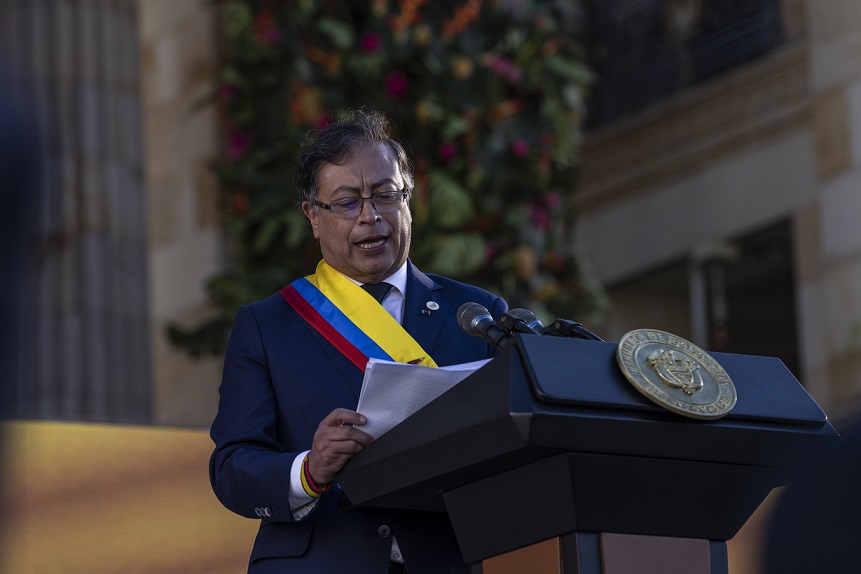
In a recent interview, the Cuban ambassador in Bogotá, Javier Caamaño, acknowledged the transparent, public and notorious stance of President Gustavo Petro against this designation, unfairly conferred by the United States in January 2021, a few days after Donald Trump left the White House.
‘This government came to power on 7 August 2022. On 11 August, former foreign minister Álvaro Leyva was in Havana making a public act of vindication of Cuba for a previous position that unfortunately led the island to be on that list,’ he said.
This classification was the result of a “clumsy and absurd political decision that believed that a guarantor country – as Cuba was and is in the talks between the Colombian government and the National Liberation Army guerrillas” – could be asked to capture one negotiating party and hand it over to the other.
In his view, this makes no sense and has no precedent, and there is no possibility for a guarantor country to do this because it would put an end to negotiations in the world.
As current Foreign Minister Luis Gilberto Murillo acknowledged, the current Colombian administration has set out to vindicate Cuba’s image and reverse an act of injustice.
 “President Petro gave the instruction precisely to take the necessary steps to ensure that Cuba was removed from the list. This is what we did from the embassy in the United States; it was a topic of discussion in the conversations that President Petro had with President Joe Biden and Ambassador Daniel García Peña continued with these steps”, he said. President Petro, Vice President Francia Márquez, the Foreign Ministry on behalf of the National Government, the Parliamentary Group of Friendship with Cuba in Congress, the Delegation in Dialogue with the National Liberation Army and dozens of politicians have welcomed the announcement. The Colombian Movement of Solidarity with Cuba and the Association of Cuban Residents also joined in.
The Delegation in Dialogues with the National Liberation Army, for example, described the measure as an act of elementary justice, as it assured that for decades the island has been making a valuable contribution to the search for and construction of peace in New Granada.
 Another politician who welcomed the agreement was former President Juan Manuel Santos (2010-2018), under whose administration the Final Peace Agreement between the former Revolutionary Armed Forces of Colombia-People’s Army and the government was signed in 2016, and for which the island was a guarantor.
On the other hand, both President Petro and Vice-President Márquez welcomed the measure, but described it as incomplete. The head of state considered that eliminating punitive measures, even partially, constitutes a step forward, while the vice-president recalled that it is still necessary to lift the blockade that the United States has imposed on Cuba for more than 60 years.
Likewise, the Cuba Solidarity Movement considered that the measure announced the day before by Washington represents for Colombia a reason for joy and satisfaction, since the country will no longer appear to the world as an ally of this criminal policy, which has contributed to the deterioration of the living conditions of the Cuban people.
 He also denounced the fact that Cuba is still resisting with dignity an infamous economic, commercial and financial blockade imposed by the US authorities, which generates serious limitations in access to basic family products and essential medicines. PL
(Translated by Cristina Popa – Email: gcpopa83@gmail.com) – Photos: Pixabay










.jpg)












