
To appreciate the importance of this publication – the first book on Central American art – take a look at its introduction, available for reading on the publisher’s website. The introduction has the names of the 40 artists featured in the book and some images of their work.
 Sean Sheehan
The author, Kency Cornejo, whose family is Central American, has spent twenty years travelling in the region and discovering artists at work there. Talking to some in the wake of the El Salvadoran civil war helped her realize how violence, against indigenous people and LGBQT communities, the criminalizing of the young and the separation of families through the migrant experience would shape the focus of her book.
The title, “Visual disobedience”, is fully earned by the stunning diversity of the images of eighty artworks filling its pages. Some of the art is performative, as when Regina José Galindo carries and places on the ground a bloody bowl into which she places her feet. Galindo’s work consistently indexes how colonialism’s legacy is bound up with gender violence: ‘centering her body’, writes Cornejo, ‘as a site of intervention to reveal the deeper structure of femicide, as a decolonial disobedience against the patriarchy’.
An example of the work of Nicaraguan Elyla (Fredman Barahona), “Ni azul blanco ni rojo negro”, is also shown in the book’s introduction and its iconography explained. Elyla’s performance art for the XI Biennial of Nicaragua was banned only hours before he/she was scheduled to appear but it went ahead anyway and became a trigger for questioning ‘the heteronormative narratives of Nicaragua as a revolutionary nation-state’.
 Stills from the video work of Costa Rican artist Marton Robinson are also featured, exposing the anti-Blackness of his country. As a child, Robinson was forced to read Cocorí, a children’s book about a young boy, racialized as uncouth and dirty (like ‘Memín Pinguín’ in Mexico), becoming enamoured with a white girl who arrives by boat on the coast where he lives. Civilization and modernity, it seems, arrives from Europe.
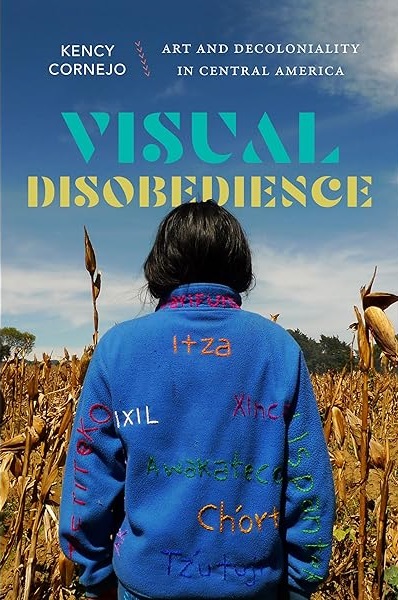
Edgar Calel’s “B’atz constelaciones de saberes”, chosen for the book’s front cover, sums up issues of migration and the defiance of creative resistance celebrated in “Visual Disobedience”. A video, ‘Not all things are for sale’, about Calel and his respect for Guatemala’s indigenous communities is available on the Tate Gallery’s website.
Kency Cornejo observes how art from Central America has been rendered invisible by the art world and the cultural establishment as a whole. Her book is a vital and welcomed step forward in challenging this erasure.
 Like Myra Barraza’s photograph in the book, of volunteers writing messages to migrants on balloons before releasing them in the air, “Visual disobedience” sends a visual signal to anyone interested in Latin American art.
“Visual disobedience: art and decoloniality in Central America” by Kency Cornejo is published by Duke University Press. Another review is available in the Morning Star newspaper.
(Photos: Pixabay)










.jpg)












