
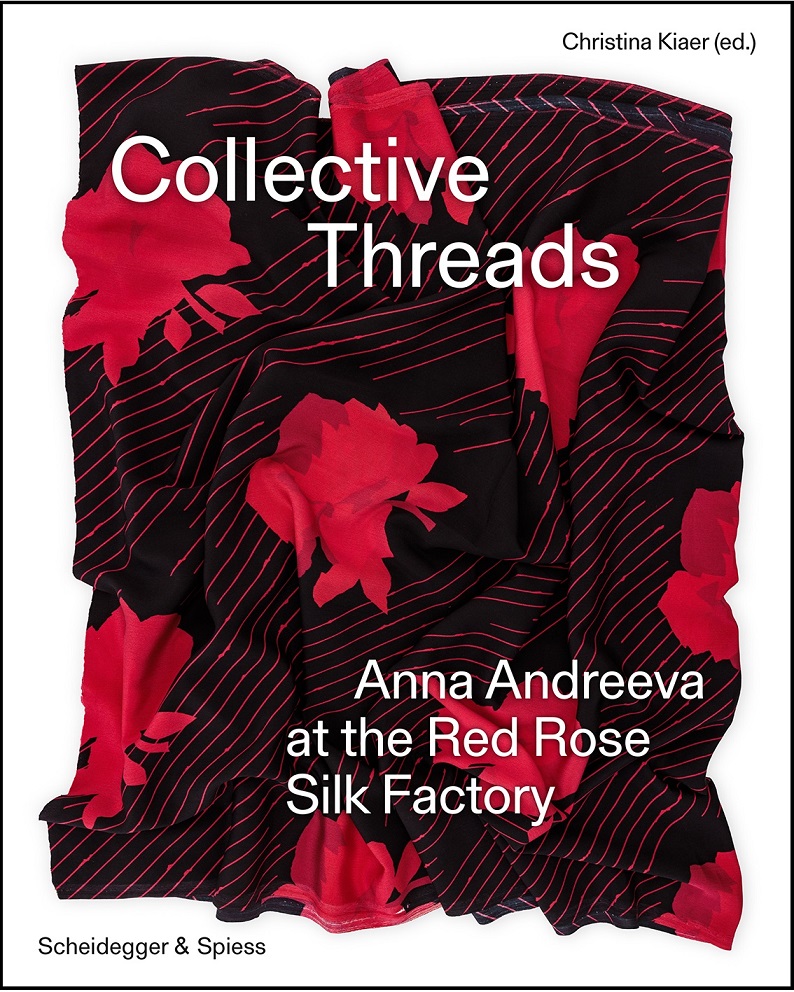
The Soviet textile artist Anna Andreeva (1917-2008) worked at the Red Rose silk factory in Moscow from the 1940s to the 1980s. Inspired by the Russian avant-garde, primarily the Constructionist movement, her work broke down simplistic divisions between high art and craft.
 Sean Sheehan
The Constructivist movement, taking shape after the October Revolution in 1917, envisaged a new role for ‘artist-productivists’ within Soviet industry. Art would produce objects of everyday life for life under socialism, in the words of a Constructivist theorist Osip Brik: “There is a consumer who does not need pictures and ornaments and who is not afraid of iron and steel”. This consumer is the proletariat. With the victory of the proletariat will come the victory of Constructivism. The Russian avant-garde is not a term restricted to Russia, for although the artists worked in Moscow and St. Petersburg they also came from the Baltic States, Ukraine and Belarus.
This book, “Collective threads”, tells the story of the movement as it affected textile design and production and its value lies in bringing together a wealth of information, photographs of the artists and images of the designs they produced. They worked, for example, on designs for scarves commissioned by the government which would be used as gifts by soviet citizens. Commissions also came from organizations like the Club of Energy Workers in Moscow –“Communism equals Soviet power plus the electrification of the entire country” (Lenin) – and Andreeva incorporated pylon patterns into her designs.
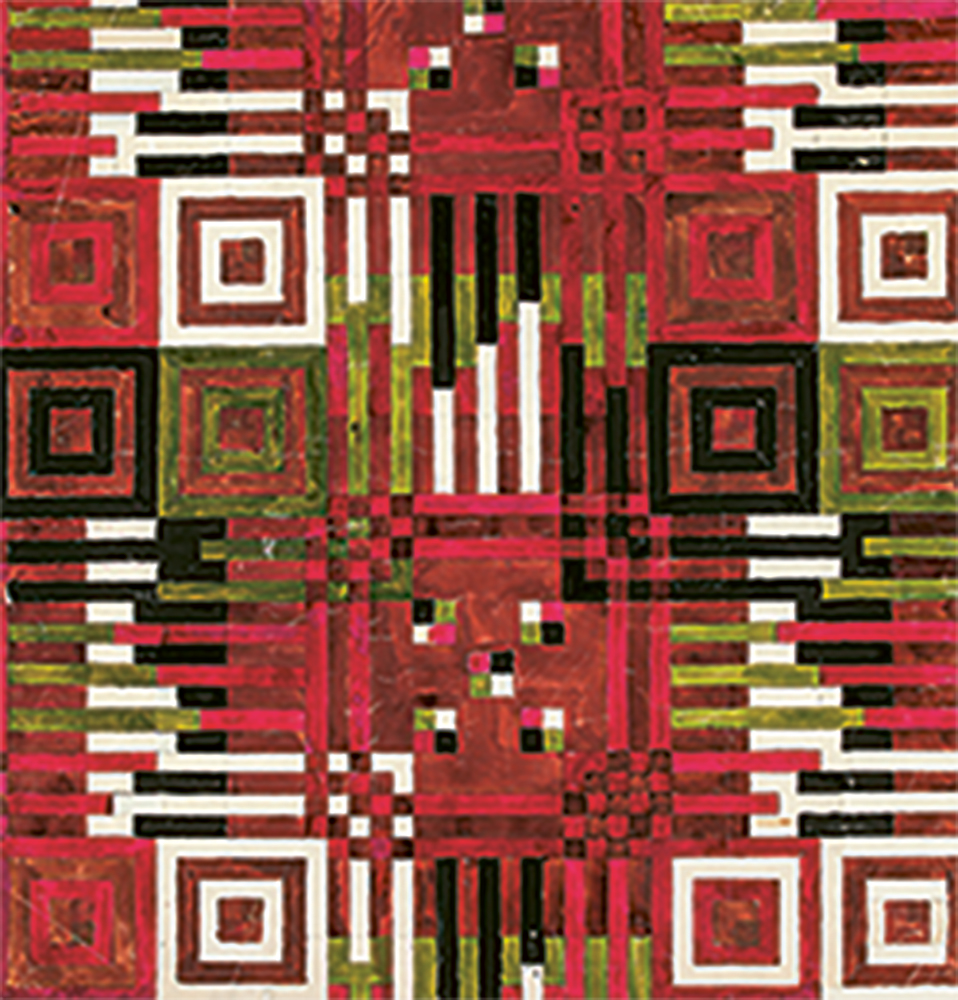
Andreeva liked to work on abstract patterns, often with mathematical precision, and she was influenced by studies into how information was communicated by machines, electronic devices as well as the brain. An interest in cybernetics peaked in the 1960s and ‘70s and there are many examples of its influence in her work.
A textile industry, thriving in pre-revolutionary Russia as one of the most advanced in the world, continued to experiment and remained open to new influences. Andreeva played with the ‘chicken’s foot’ or houndstooth pattern, a part of the family of Scottish tartan fabrics which took on elite associations when Christian Dior launched the perfume Miss Dior in 1947. The perfume was sold in bottles etched with a houndsooth print and increased in popularity with the Op art movement of the 1960s.
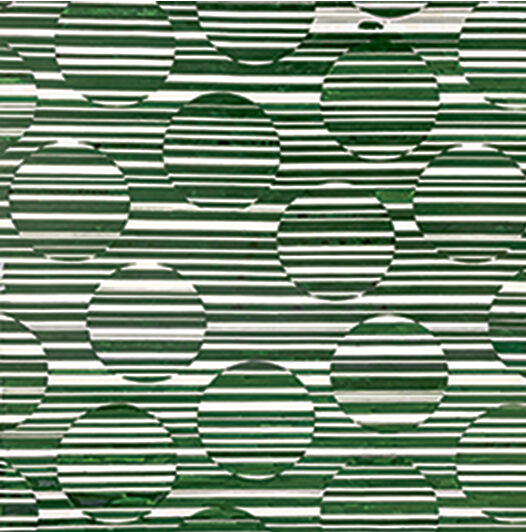
Andreeva’s archive remained private until 2018 and this book is built on what was revealed when it became public. It confirms how important the aesthetic of the Russian avant-garde – its injunction to break down the division between art and life – was to her. Her commitment to this principle was not destroyed by Stalinism’s crass imposition of Socialist Realism and the persecution of artists in the 1930s. In the words of one of the contributors to this book, she ‘happily inhabits an utterly unheroic moment in Soviet history…remote from the fiery rhetoric of the early twentieth-century avant-garde’.
“Collective threads: Aanna Andreeva at the Red Rose Silk Factory”, edited by Christina Kiaer, is published by Scheidegger & Spiess.
(Images supplied by the publisher)










.jpg)












