
More than folk tales, Brazilian folklore is a testimony to the country’s cultural history. Characters such as Saci-Pererê, Curupira, Iara or Boto reveal the fusion of Indigenous, African and European traditions. Far from disappearing, these mythical beings continue to reinvent themselves and engage with the present, preserving the identity of a syncretic people.
 Diony Sanabia
Far from disappearing, these characters continue to reinvent themselves and engage with new audiences. They are a living memory passed from generation to generation, capable of explaining the relationship between being human and nature, preserving ancient traditions and embodying the identity of a people that made cultural blending one of its defining cultural characteristics.
According to folklorist Luís da Câmara Cascudo, an authority on the subject, folklore represents the knowledge that the people conserve and pass on spontaneously through time. In his Dictionary of Brazilian Folklore, the result of decades of research, he argued that folk legends are not simply fantasies, but testimonies to the country’s cultural history.
According to Cascudo, no tradition is born in isolation, as all of them incorporate elements from different peoples and periods, adapting to new realities without losing their essence. In Brazil, Indigenous beliefs have become intertwined with stories brought by the Portuguese colonisers and with the rich spiritual world of enslaved Africans.
Perhaps no character represents this diversity better than Saci-Pererê.
With only one leg, a red cap, a pipe in his mouth and the extraordinary ability to disappear in whirlwinds, this naughty boy is known to hide objects, tangle horses’ manes and play tricks on those who travel along rural roads.
But behind his playful image, there is a complex cultural construction.
 Researchers maintain that the character was born from ancient Indigenous traditions in the south of Brazil, and gradually took on African and European traits, becoming one of the country’s great national symbols.
His popularity reached extraordinary dimensions thanks to the writer Monteiro Lobato, who turned him into the protagonist in “Sítio do Picapau Amarelo”, which has a television adaptation. Since then, generations of Brazilians have grown up listening to his adventures and learning that ingenuity is often more valuable than strength. Whilst Saci-Pererê represents mischief, Curupira symbolises respect for nature. With a thick head of reddish hair and famous for having, this protector of the forests fools hunters and loggers that needlessly destroy the jungle.
Long before concepts such as sustainable development or environmental conservation appeared on international agendas, Indigenous peoples used the figure of Curupira to teach that natural resources should be used responsibly.
And if Curupira rules the forests, the waters belong to Iara.
Beautiful, mysterious and the owner of an irresistible voice, the so-called “’Mother of the Waters” lured fishermen and sailors with a hypnotic song until they disappeared into the depths of the rivers.
Experts consider that this figure embodies ancient Indigenous stories about protective spirits of the waterways mixed with tales of European mermaids brought during the Portuguese colonisation.
The immense Amazon also gave rise to another of the country’s best-known tales: the Boto-cor-de-rosa.
 According to tradition, this Amazonian dolphin leaves the river during night-time festivities to transform itself into an elegant young man dressed completely in white, always with a hat to hide the blowhole on his head.
After seducing a young woman, he returns to the water before sunrise, leaving behind unexplained pregnancies or impossible loves.
Beyond the fantastical nature of the story, sociologists and historians have pointed out that for a long time this legend helped to explain pregnancies outside marriage in isolated communities in the Amazon. Another creature deeply connected to the defence of nature is Boitatá, a gigantic fire snake whose eyes shine in the midst of darkness.
Depending on the region it can appear as a luminous ball or a reptile wrapped in flames, but it is always punishing those who set fire to the countryside or destroy vegetation.
The stories about Boitatá were probably born from observations of luminous phenomena in swampy areas and were reinterpreted by rural communities as warnings against forest fires. Among the characters that inspire the greatest fear is Cuca.
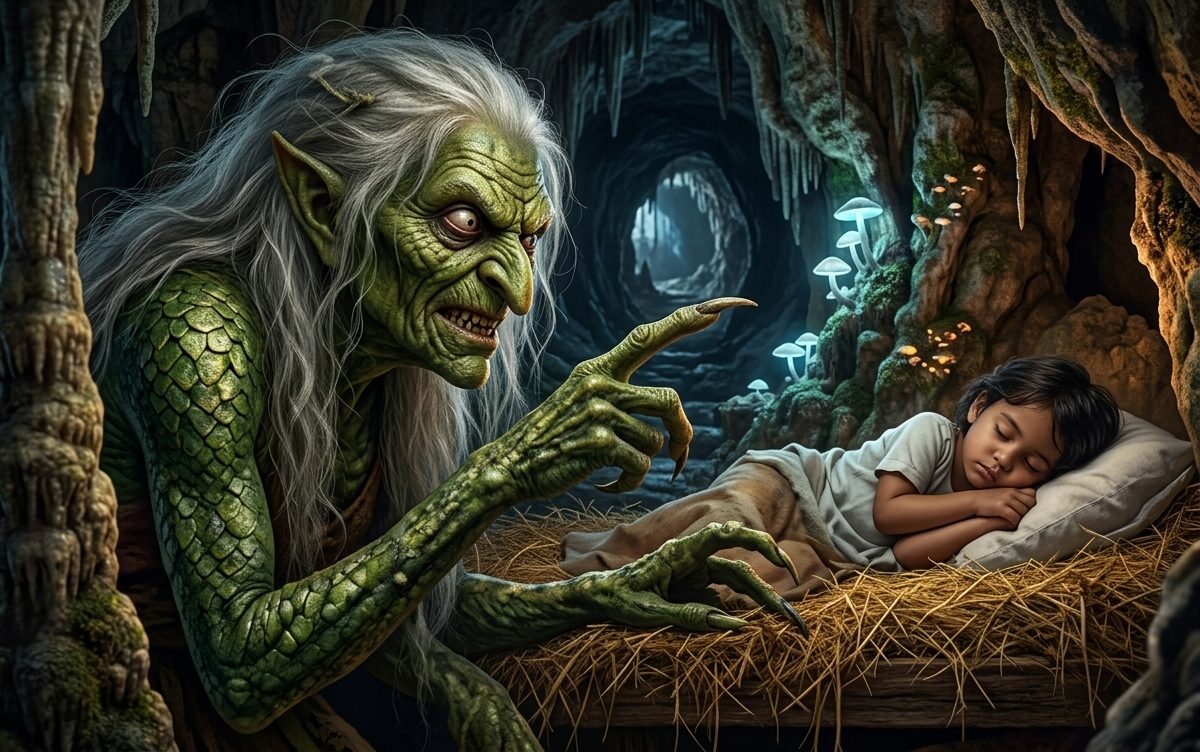
Her current form, an elderly woman with a monstrous appearance and reptilian features, stems from ancient Portuguese legends adapted to the Brazilian context.
 For centuries, she was used to frighten disobedient children and persuade them to go to bed early.
Children’s literature eventually softened her image, although she remains one of the best-known villains in the popular culture of the South American giant.
The story of Negrinho do Pastoreio is very different, deeply marked by the country’s history of slavery.
The tale tells of an enslaved black boy who was brutally punished for losing some horses and, after mysteriously disappearing, began helping those who lost objects or animals. Many people in southern Brazil still light a candle to Negrinho before beginning a search, convinced that the little boy will intercede to recover whatever has been lost.
For historians, this legend is a powerful metaphor for the violence of slavery and, at the same time, a symbolic revindication of the dignity of those who were subjected to it for centuries.
The Headless Mule also occupies a prominent place in popular imagination. According to tradition, a woman who fell in love with a priest was condemned to transform herself into a headless horse that breathes fire from its neck as it gallops through the night.
Researchers interpret this tale as an expression of the strong religious influence on colonial society and of the mechanisms used to reinforce moral norms concerning female sexuality. Very close to Curupira appears Caipora, considered by many Indigenous communities to be the protector of wild animals.
Hunters used to leave tobacco leaves before venturing into the forest to ask for permission and avoid angering her.
 For the writer and researcher Sílvio Romero, the popular legends represent a historical document as important as any official archive, as they reveal how communities interpret the world, confront their fears and pass on knowledge to new generations.
This ability to adapt explains why folklore characters have survived into the 21st century and today feature in films, television series, comic books, video games, theatre productions and digital content that keep a centuries-old tradition alive. PL
(Translated by Carol Byrne) – Images generated by Gemini AI










.jpg)












