
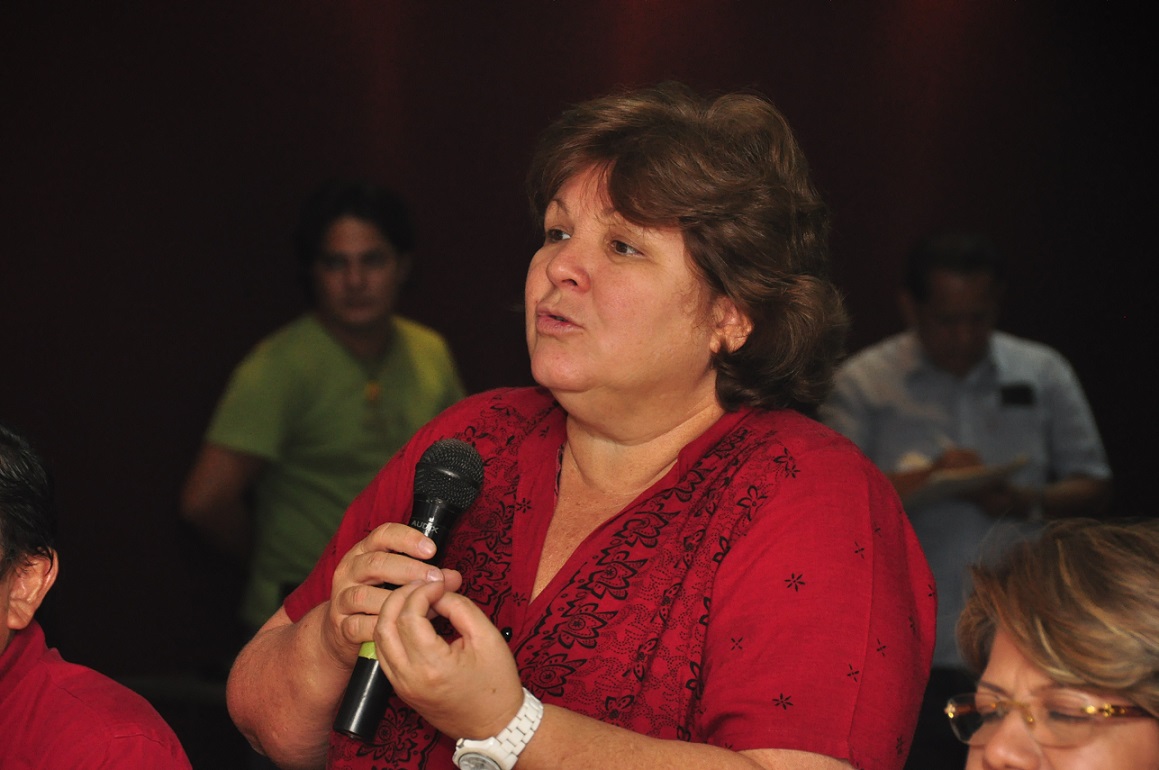
Aleida Guevara has come to the UK to mark the 45th anniversary of the execution of her father Ché Guevara.
Graham Douglas
–
When I arrive she is sitting alone at the podium in a House of Commons Committee Room while preparations go on around her for a meeting in support of the Miami Five. Evidently she is tired after more than a week of meetings and interviews in many parts of the UK, campaigning for decent treatment for these prisoners, maltreated by the United States justice system.
Fighting injustice and providing medical care are the issues which have concerned her most.
She is trained as a pediatrician and nowadays works at the William Soler Hospital in Havana, but the years she spent in Angola, Ethiopia and Nicaragua have made her aware of the pain suffered, especially by children in developing countries.
Suffering which is made worse by corrupt and despotic regimes, and nowadays by neo-liberal economics. And this is where the personal becomes political: the Cuban Revolution expanded internationally during the 1970’s, and Ché was executed in Bolivia as a result.
Talking about her life and the Cuban Revolution today, she also focuses on the simplicity of relations between people, the importance of honesty and mutual tolerance, in a way that recalls the writings of Tom Paine over 200 years ago during the United States Revolution.
 Today these simple concerns may seem childlike in political terms, but now that the United States has become a monster spreading war and consuming resources all around the planet, we can contrast them favourably with the way the greatest power on earth is still attempting to crush the Cuban Revolution, like a jealous child.
In conversation with The Prisma, Aleida Guevara asks us to look at how much of the modern world has been made inhuman, by so-called advanced societies.
Can there be a reconciliation between the Cubans living in Cuba and those in the United States?
Yes, except for those people who don’t want a reconciliation: those who are not interested in a relationship with Cuba, or those who simply make money from being against the Revolution, a business they have been running for years. These people will never accept relations with Cuba. But with the others relations are very easy, they spend their holidays in Cuba without any problems at all.
Why does the US persist in the blockade, when the Soviet Union is no longer here to support the island, and when Cuba has long since stopped exporting its Revolution to other countries?
The first reason is purely economic, because Cuban society has proved that it can live in a different way.
But to do this we as a people must be the owners of what we produce. Venezuela is an example of what I mean. What price did they use to charge the US for oil? Between 5 and 7 dollars a barrel.
 Now they are selling it at the international market price, and this has affected the economic interests of the US. They have always felt themselves to be the owners of our America, as if we were in their backyard – so when other nations take hold of the reins of their own destiny and become the owners of the wealth they produce, the US is going to be affected. Because for all these years they have continued to steal from us, plundering our resources. So, if Cuba offers this example that it is possible to live in a different way, and that actions can be taken to make this happen, this does not suit the US government, and they are doing all they can to strangle the revolutionary process in Cuba. That’s why the blockade continues.
Cuba is an example to others which the US cannot tolerate?
Absolutely not, because once the example of Cuba begins to multiply in other countries, especially in our continent, they are affected economically – and especially the big trans-national companies.
The neo-liberal policy of recent years is based on the plundering of our resources – shall we say, in a more sophisticated way than during colonial times – but it is the same thing. Let’s take a simple example: right in the heart of the Brazilian Amazon there is the second biggest opencast iron mine in the world. So if I ask you does the human race need iron for manufacturing many things? Yes, of course, but which is more necessary for our survival: iron or oxygen? Despite that, we continue destroying Amazonia at a huge rate, and it will never recover. We are losing maybe the last remaining lung on the planet. And for what reason?
So that some companies can buy this iron at minimal prices, and on top of that, they sell us the goods they manufacture from it at exorbitant prices.
Let’s suppose that Brazil decided to re-nationalize this company and impose international market prices. Then the big trans-national companies who are now extracting this iron would face a difficult situation.
 Or, let’s imagine that Brazil decided to close the mine because of the damage that it is doing to their own infrastructure, as well as that of the whole planet.
What effect would that have on the business of the people who have invested thousands and thousands of dollars in this mine?
That is what they worry about, not losing business.
And that is why they put pressure on Cuba to stop it from transmitting its example, that when a people joins forces and decides to change their destiny, they can succeed. And no-one can stop them.
You have said that education in the developed countries puts too much pressure on children. How do Cuban schools work in contrast?
Something that we try to protect in Cuba is a healthy childhood, lived to the full, so that they play sports as well as having a good academic education. But not having them sitting all day in front of a computer. We want them to play, to have physical education, to be able to feel alive, so that the energy they have is used up in physical exercise.
Things like computers are damaging to a child when used in this way.And something which I have noticed in many developed countries, is that after school, as soon as they get home they spend all their time with computer games, staring at a screen.
 They are losing the spontaneity of children, losing those friendships that childhood and adolescence can give them, relationships with other human beings, being involved with other things, not just themselves but with what is happening around them.
You have also said “people can change through being aware of their surroundings”
Someone I met here in England told me about a young person who went to Cuba and was changed by the country. But it wasn’t Cuba which changed her. She had the qualities, the human sensitivity that made her interested in what was happening there, and could draw her own conclusions. What Cuba offered her was the discovery that a society existed there which was different from the one in which she was living.
But it didn’t change her: it simply provided the chance for her to express these feelings, which previously, she had not had the opportunity to do. And that is why I always make the point that a human being coming to a new place always needs sensitivity in order to pick up on what is going on around them.
They need to have a lot of respect for the people around them, and never think themselves superior to others.
 On the contrary, we always need to realise that we can learn from even the simplest person, because they can teach us something as long as we are able to listen and respect them.
Our society could be more human, more beautiful, if we were able to respect each other, and to learn about our own differences. That would certainly make us better human beings.
Does Cuban society encourage this attitude of respect for others?
Of course. People ask me if I do what I do because I am Che’s daughter.
And I say no, I feel myself a woman with something to offer society, because I was brought up by my people , by my revolution. That is very important, because it doesn’t matter if you are someone’s son (hidalgo), what makes you a better human being is feeling that you are useful within the society you belong to, you defend, and which you believe in.
And that is true for most Cubans living in Cuba. We are convinced that this is what we want, and what we need. Of course we must do our best to improve it, we have very many problems to resolve which are thrown up by daily life, but that is our privilege, our right to solve our problems by ourselves, it is not for anyone else.
“Respect for the rights of others is the way to peace”…
That is what Benito Suárez and José Marti said, and it is in our constitution as well: “El respeto al derecho ajeno es el camino a la paz”.
How does this concept of respect apply to dissidents, to those who do not agree with the present regime in Cuba?
I have always said that I would like to meet a real dissident. ‘Dissident’ means that you think differently from me, that we have different ideas and concepts. And that can be respected: we do not all have to think in the same way.
 What I cannot respect is when you say these things because there is someone behind you who is paying you, when you are receiving money from a foreign power- very often the United States – to support you in what you are doing or the positions you take.
Then I cannot respect you because I don’t believe that you have this strength, but that you are playing a game in order to have a more comfortable life, and selling yourself as a person.
I always say that I would like to meet a true Cuban dissident, someone who says what they think without receiving a single dollar in payment, or someone who feels something against our revolutionary process. Just one: but so far I have not had that pleasure.
(Photos: Pixabay)










.jpg)












