
At the beginning of February, in front of a very large audience, a talk given by renowned activist and academic Professor Ilan Pappé at the Colombian Consulate in London showed that solidarity with the Palestinian people continues to grow in different parts of the world, despite attempts and actions to silence or end any support.
 Jonathan Montoya
In an emotional speech on 1 May last year, Colombian president Gustavo Petro announced his country’s cessation of relations with Israel “for having a genocidal government”. It was then that he said: “If Palestine dies, humanity dies, and we will not allow that to happen”.
Almost a year has passed and the killing of tens of thousands of Palestinians, of those displaced, wounded and dispossessed of their property and land, continues to feed a picture of permanent barbarism.
From different parts of the world, millions of voices, grouped or individual, have risen up to demand an end to the destruction of the Palestinian people. They have done and continue to do so through marches, protests, conferences, lectures, debates, writings, letters and more.
This is the case, for example, in London, where there is a strong pro-Palestinian movement. From the Colombian community, but also by putting together a solidarity group of different nationalities, different activities have also taken place. One of them was at the beginning of February at the Colombian Consulate in London, organised by pro-Palestinian activists.
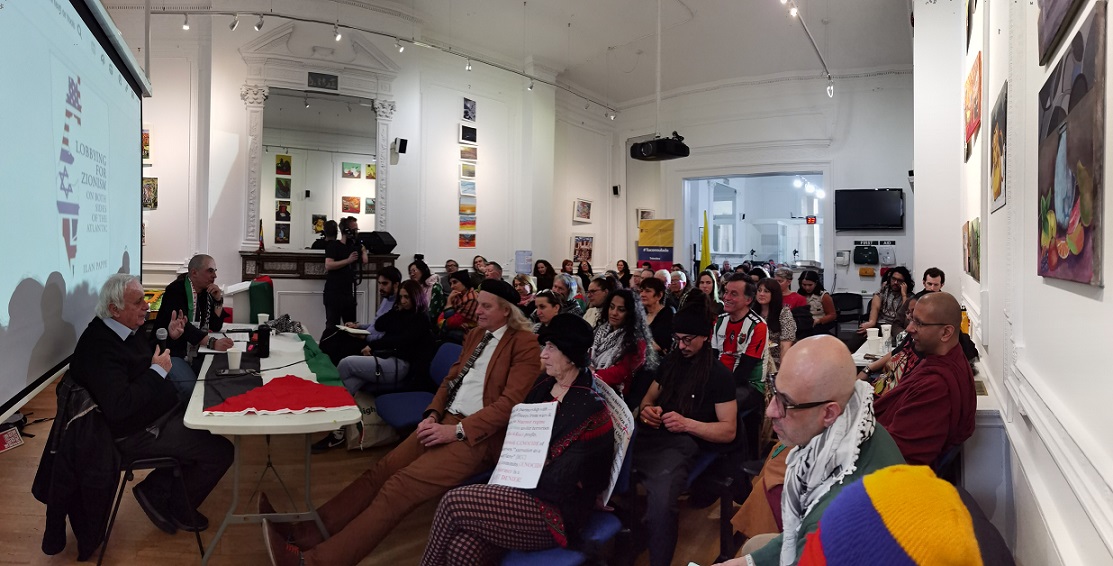
The conference, entitled “If Palestine dies, humanity dies”, aimed to provide Palestinian activists with the necessary tools “to fight the battle of ideas, because when we are on the streets protesting, we are not just making noise, we are arguing; we are making a case. That is our battle. Our weapons are books and intellectual exchange”. So said Yonatan Mosquera, a London-based trade unionist and anti-apartheid activist who chaired the event.
The lecture was given by renowned activist and academic Professor Ilan Pappé, who explained that severing relations with Israel is “one of the most important non-violent means of forcing a colonising and apartheid state, a state that perpetrates ethnic cleansing and genocide”, to change its brutal course. He mentioned the cases of previous vicious regimes that have been dismantled, such as South Vietnam and apartheid South Africa, and “what happened in those places can also happen in Israel”, provided there is sufficient pressure from other states, starting with sanctions and the breaking of diplomatic relations.
A historical step
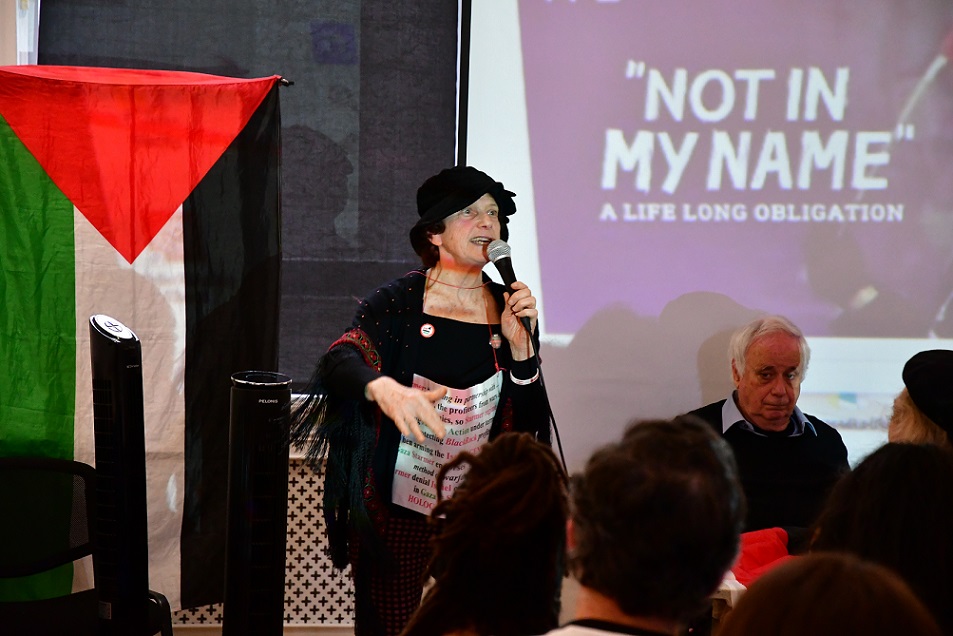
Also present at the event were writer and humanitarian worker Victor de Currea Lugo, who gave an overview of the measures taken by the Colombian government in opposition to the ongoing genocide in Gaza, and Yael Kahn, an Israeli and veteran of the anti-apartheid movement in the UK since the 1970s. She presented her views on the way forward for the anti-genocide movement.
They were joined by Mamdouh Jabbar, the first Palestinian representative assigned to Colombia, who spoke about his experience on his arrival in Bogotá, and Ibrahim Assalia of the General Union of Palestinian Journalists, who shared the current perspectives and hopes from his birthplace, Jabalia, regarding Palestinian liberation.
Yael Kahn supported the call for Israel to be sanctioned. She added that it should also be expelled from the United Nations (UN) as the Zionist state has a world record of assassinations against UN employees, routinely jails and tortures UN staff, has banned UNRWA, attacks UN peacekeepers and violates all UN resolutions regarding Palestine.
 Yael Kahn went further, calling for Israel to be expelled from all international sporting, academ
ic and professional bodies. “Colombia – she said – is showing us the way, but we cannot take Colombia for granted,” said Kahn, and urged attendees to mobilise solidarity with Petro’s government, as “the Zionists will continue their attempts at internal destabilisation.”
The shift in European politics
Kahn referred to the case of Issam Bassalat, a Palestinian doctor from Edinburgh, who has languished in a UK prison since 2020 following trumped-up charges resulting from an MI5 sting operation. Bassalat is well known for championing Palestinian rights in the UK and Europe, including a demand for the UK to apologise for the Balfour Declaration.
For his part, Pappé explained that Theresa May’s celebration of the Balfour Declaration in 2017 marked “the most immoral British act for many years”. However, he added that a shift is taking place in the political debate within Western Europe.
He quoted the Oslo initiative promoted by Dr Mads Gilbert and others, who insist that “we [Europeans] are not mediators and were never honest mediators. Now we are the allies of the Palestinians, that is our historic role, to side with the Palestinians’.
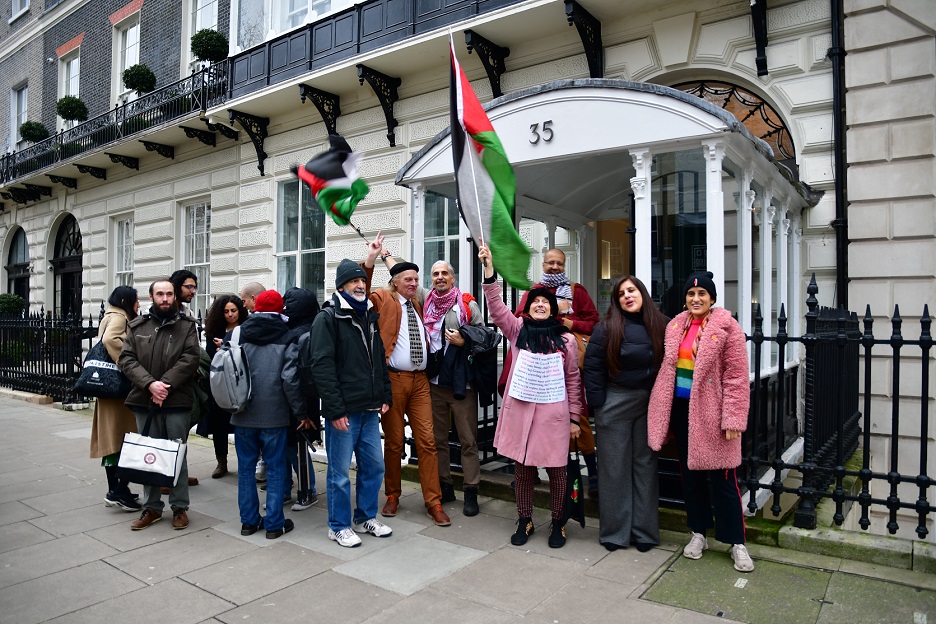
Similar campaigns should be launched in the UK because, without the complicity of the West, it would have been “impossible to create this kind of apartheid state”, Pappé added.
A younger perspective
Pappé also referred to the younger generation of Palestinians, at home and abroad, who are “much more determined about the vision for the future. They have a clearer idea of what they want”, which is positive.
However, Palestinian youth are not the only source of hope. Pappé noted that Jewish youth outside Israel are also experiencing a positive transformation. The more they learn about Israel’s brutality, “the less they want to be associated with it”. Instead, they find that Judaism helps them to identify more with what is happening in Palestine, “and this pushes them to be part of the solidarity movement with the Palestinians”.
Pappé spoke of his own experience of transformation from a young Israeli born into a family that supported Zionism to an activist for Palestinian rights, and expressed the hope that more Israeli Jews would follow his example. “I am not the only one; we are working within Israeli Jewish society, we are not going to give up; activists have to be active everywhere, wherever they can work, they should work.”
 The world that we want to build
That reality that needs to be changed goes beyond Palestine: “We face not only the power of the pro-Israel lobby, which tries to silence any support for Palestine through intimidation and false accusations of anti-Semitism and terrorism. We also face all the illiberal forces, all the anti-democratic forces in every single Western country that take the opportunity to make these states much more like police states, even under the guise of democracy”.
He added: “They are using the Palestine issue to make sure that people remember that they can’t freely say what they want, that they can’t freely speak out for what they want, that there is the kind of Big Brother state that can shut them down and shut them up”.
To conclude, Yonatan Mosquera said: “The more democratic, the more representative, the more authentic the politics in the West, the better for the Palestinians and the worse for the Israelis. The more populist, fascist, neo-right and anti-democratic Western politics are, the better for Israel and the worse for the Palestinians. The Palestinian issue is the one that decides the future of humanity. It decides what kind of world we want the next generation to live in.”
(Photos by Pedro Blattmann, provided by Yonatan Mosquera and authorised for publication. Plus photos from Pixabay).










.jpg)












