
It seems we are living in a post-truth age. Politicians and the mainstream media fluently inhabit such a world. We are bereaved of truth, sculpted from social and political discourses, subject to the prison house that is language, and reality becomes an adjustable construct.
 Sean Sheehan
The diverse essays in “Indirectness” take all this – it used to be called postmodernism – on board without endorsing its simplistic conclusions. Instead, they explore how the only way to reach the truth is by coming at it from the side; by way of a detour, the wrong train takes us to the right station.
Repeat a word enough times and its inherent meaninglessness can be heard. Its sound is arbitrary but, through agreement and convention, users of a particular language accept the sense that is associated with it. Those dealing with untruths are able to make use of this, twisting meaning because there is no hidden or universal essence to truth.
Therefore – the saving grace – truth must emerge indirectly. When we enjoy a pun, the subject of one of the essays, the truth that there are no axioms for deducing what is true takes us by surprise and is not directly stated. Similarly with Christianity, as another essay argues, little is gained by stating the obvious truth that God does not exist; it only encourages believers to argue against the proposition. Instead, it is God who does not, in his unconscious, believe in himself and his Son realises this at Calvary (‘Father, why has thou forsaken me?’).
By ranging from punning to Christian atheism – using psychoanalysis, art, cinema and politics – “Indirectness” gives body to its philosophical impetus: the claim that reality is not complete but imbued with a negativity that fantasy tries to fill. The universe is foreign and we are foreigners to ourselves. Desire, in the psychoanalytic sense, gives expression to the unrest that abides with being’s imbalance, and the wellness industry holds out the promises of methods that will deliver a direct but impossible fulfilment. Through various deployments – a diet, a spa, meditation or pills – the industry’s methods premise the individual as a private person and, one step away from this, the other person becomes the site of a potential threat. Mobile phones contribute to the decline of authentic conviviality and, as a contributor notices, the ubiquity of posting platforms seduces people into immediately publishing their silly, impolite or dangerous thoughts. The antidote to wellness- and posting-mania calls for fidelity to political togetherness and cordiality, hence the “Comrade: a body for politics” essay in this stimulating collection of articles.
The final article considers cinematic representations of indirection and there is an engaging if not entirely convincing championing of Tarantino’s films. They are seen to subvert Hollywood clichés by rewriting traditional themes of revenge and victimhood through emphatic espousals of marginalized groups, like black people and outlaws.
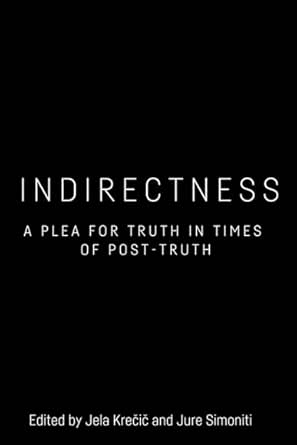
“Indirectness: a plea for truth in times of post-truth”, edited by jela Krečič and Jure Simoniti, is published by Edinburgh University Press.










.jpg)












