
The initiative to fight urban crime in Colombia is causing concern over possible abuses of power, violations of human rights, infiltration by criminal organisations and the possibility it ends up being used against social protest.
 Germán Ayala Osorio*
The incoming government’s announcement that it will tackle growing insecurity in the country’s main cities with the creation of Urban Security Blocks (BSU, in Spanish) sparked alarm among adherents of president Gustavo Petro. President Petro himself described the strategy as “creole fascism” that will fan civil unrest.
Of course, there are risks that the operation of these Urban Security Blocks could attract undesirables, secret or undercover police or lend themselves to alliances with specific criminal organisations from cities like Cali, Barranquilla and Medellín, with the clear purpose of dismantling other criminal structures or physically eliminating some of their leaders. It would be a case of “settling scores” with the participation of state agents. In particular, those who “went out of control” and failed to respect pacts signed with state agents would be attacked.
Those groups that collaborate with the BSU will continue operating and fulfilling tasks such as contract killing, targeted robberies and micro-trafficking.
To put it more clearly: just as happened with the Search Block which pursued drug traffickers in the 1990s, the BSU will normalise connivance between legals and illegals.
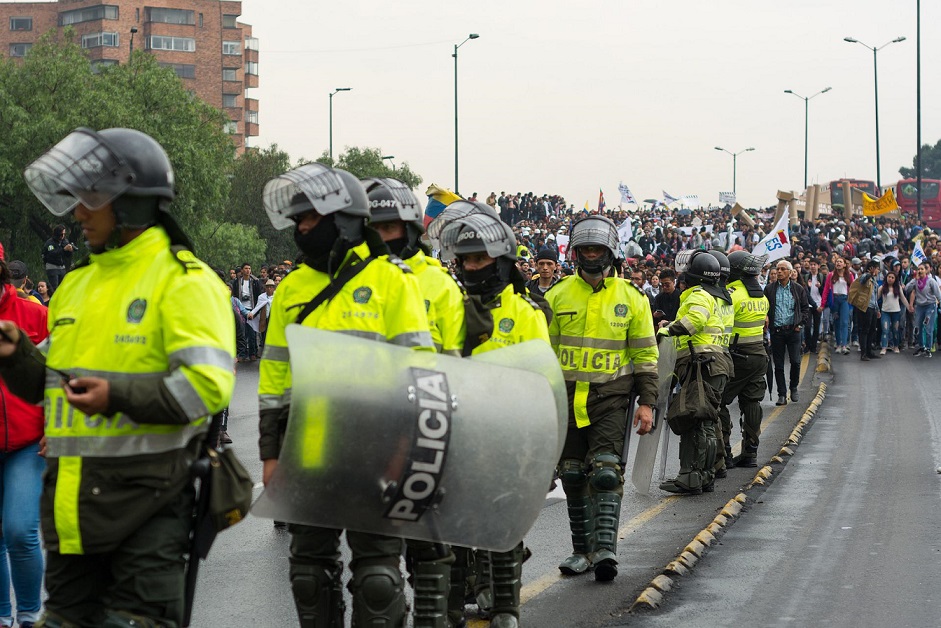
 The BSU will operate legally supported by the “urban terrorism” declaration with which they will pursue young people who took to the streets to show their discontent at the arbitrary acts committed by the police and the economic decisions taken during Iván Duque Márquez’s government.
Vandals and those who went out to protest could end up being persecuted by agents of the Urban Search Blocks.
Let’s not forget that during the civil unrest the young people of the First Line were described as “terrorists, vandals and hordes of savages”. Although it is an announcement at present, the decree that will give legal and political life to the Urban Security Blocks will be known on 7th August when De la Espriella, the creole “Bukele”, is sworn in. The BSU’s operational results will be aligned with the ten mega-prisons the president-elect promised to build during the electoral campaign.
Remember that these will be privately-run prisons whose financial success will depend on the quantity of prisoners in them since the state will pay the private companies who take on the construction and operation of the ten prison complexes “by the inmate”. Without prisoners, the business is not viable, so massive numbers of captures will be necessary.
 Naturally the proposal was immediately very well received by the mayor of Cali, Alejandro Eder, who thinks the same as De la Espriella. This was his terse message on X: “The Urban Security Defence Block is heading in the right direction.
We have already seen in Cali that when the military and the police, the Office of the Attorney General and the intelligence agencies work in a co-ordinated fashion, results come.
Now the challenge is to double down on the strategy to forcefully tackle the more than 100 criminal gangs affecting the safety of our city and of many regions of the country. Cali is ready to bring our experience and to work in a co-ordinated way so that citizens can live without fear and so that criminals face justice”. The curious thing about this and other strategies launched by previous governments is that none of them emphasise the dismantling of the networks that facilitate the purchase, sale and distribution of weapons, ammunition and explosives. In Cali weapons are hired to commit murders and robberies and the authorities do very little to try to dismantle the structures that operate between legality and illegality.
Hopefully the Defender of the People, Iris Marín, will put the BSU’s operations under the microscope so they don’t end up turned into a new strain of Convivir co-operative and into mobile offices for the settlement of scores and the persecution of young people and community leaders sympathetic to the left and progressivism.
 It would be a real miracle if the BSU don’t end up serving criminal gangs with pretentions of being a sort of anti-left moral police. Watch out, there is more than one reservist on the right willing to “gut” lefties.
*German Ayala: Political Scientist, Contemporary Humanities specialist and Social Communicator-Journalist. Author of the blog La otra tribuna.
(Translated by Philip Walker – Email: philipwalkertranslation@gmail.com) – Photos: Pixabay










.jpg)












