
He was once an illegal immigrant. He is informal and warm-hearted, but reticent on the subject of Julian Assange and Edward Snowden. His style is different. He considers himself a revolutionary.
Noelia Ceballos Terrén
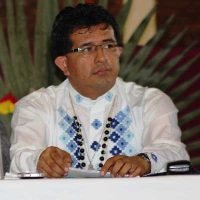
For the last four months, Ecuadoreans in London have had a new face as the head of their consulate: Juan Arcos Tuitza, the former governor of the Morona Santiago province who assumed his post on November 17th 2013.
His philosophy is, in his own words, “territory minded, not office minded”, which is reflected in his informal appearance. A crown of feathers and indigenous pendants are the symbols that he dons for many of his public appearances in order to assert his Shuar identity. His greatest challenge is that of forming bonds with Ecuadorean immigrants in London, and helping to unite them. It will not be difficult for him, as he relates how he first encountered poverty when he was living as an illegal immigrant in the United States. He comes across as reserved on the diplomatic issues that have placed Ecuador in the spotlight in the last year. One of those burning issues is Julian Assange, with whom he claims to have no relationship, unlike his predecessor Fidel Narváez.
Regarding the cause of Narváez´s dismissal – providing the ex-NSA agent Edward Snowden with a safe conduct pass without permission – he maintains that he would never have acted in the same way, “above all, discipline”.
He spoke to The Prisma about Yasuní, Venezuela, the elections in Ecuador, press freedom and Assange, among other issues.
 Why did you accept the post?
I have also been a migrant. 20 years ago I went to the USA in order to be able to continue studying to be a pilot. I know what being in a country illegally and sleeping in the street is like. I know what it’s like to not eat during the day in order to save money and pay the “coyote” that I asked for a loan to enable me to come through Mexico illegally.
For these reasons, the President felt it was important for somebody to come to this community who had one foot on one side, as a migrant, and the other in the diplomatic area, so that there is no longer a translator between what an indigenous person from the jungle feels and the rest of world.
What is your greatest challenge, in a consulate as important as London?
My greatest challenge is to be territory-minded instead of office-minded, and I invite every diplomat to get out from behind their desk regardless of their country. People need to know who their representatives are.
Ecuador is not the same as it was ten years ago. A lot of people left 20 years ago and think things about the government that aren’t true. Our duty is to publicise the work the government does for migrants. The first thing I did was to meet with all the existing organisations, whether social, political or sporting in nature. Our challenge is to put ourselves at the service of the people, because I’ve already been there.
When you look at the people of Ecuador, do you see a united community?
The thing is that everybody wants to do everything. However, here we need someone who will take the helm, and to achieve this you have to be an example.
 You feel what you are doing, and live what you are saying. This will help the community to find one or two leaders who can push that Ecuadorean boat here. I personally would love it to be a woman, they make excellent leaders. When that unity exists, there won’t be bitterness or disagreement when making decisions.
Your predecessor in the consulate carried out work that has left a mark on the Ecuadorean community. How are you planning to continue that job?
One of the things that I could capture from the work done by Fidel Narváez is for differences between Ecuadoreans if there are any, not to be too great. As an authority, the biggest mistake we can make is to give preference to certain groups, because emigrants are very sensitive.
One of the big projects within our efforts is the “virtual consulate”, so that Ecuadoreans don’t have to wait for their formalities here. Documents can also be sent to their home addresses. And to make their lives easier, because we know that on many occasions they have to take time off work only to then not be seen because of a missing document. We want to streamline that.
 What image do you want to give off by wearing typical dress?
Beyond wanting to give off an image, it is respect for my nationality. I was born in the jungle, I left for the city aged nine and learnt Spanish aged ten, but I can’t lose my identity. I only wear my crown in very special events, and that makes me feel proud.
Do you consider yourself a rebel?
More a revolutionary than a rebel. When I was living as an immigrant in New York I had never met a consul, and when I arrived there I wasn’t well taken care of. I said to myself that if I ever worked in one of those spaces, it had to be by making a 180 degree turn.
The reputation of President Correa has been damaged by accusations of a lack of press freedom. What is your opinion?
Having freedom of expression is one thing, and making licentious expression is another. In Ecuador people have been denigrated from behind the microphone. They have used rude terms in front of many people, among them my sons. I can’t make use of that space because I have power by being the owner of a TV or radio station, or make cartoons of whatever I please. I can’t label anybody without having clear and concise arguments.
How would you describe the current government’s relationship with the press?
It’s a normal relationship. There are media organisations that have had to close down, obviously. If someone with a microphone comes along to shake up citizens, the person who speaks is not the only guilty party. The media organisation that broadcasts it is jointly responsible.
 The previous consul had a close relationship with Julian Assange. Have you had any contact with him in the embassy?
I’ve had the opportunity to see him, but I keep my distance and go there for my clear objectives, to speak with the ambassador.
When it comes to diplomacy, the ambassador and the president will know what the right steps to take are.
Your predecessor was at the centre of a difficult episode when he decided to provide Edward Snowden with a safe conduct pass without permission. How would you have reacted in his case?
As consuls, we need to have the authorisation of our superiors. If what happened did happen, everyone assumes their responsibilities as citizen and civil servant. I always say that there can be mistakes that I make, but look at the virtues that exist.
How have relations between Ecuador and the United Kingdom been affected after the “diplomatic crisis” that followed Assange being granted asylum?
 There are crises in every relationship, even in the personal sphere. They are being gradually overcome. However, if this issue had been delved into further, perhaps we wouldn’t be here, neither as an embassy nor as a consulate. The appropriate responses will have to be given diplomatically, at the time when they have to be given.
What is your opinion of recent events in Venezuela?
My analysis of Venezuela is that there is a manipulative Right-wing. I encourage and aspire that we see things more calmly and positively and that we can sit down and converse with our governments before using violence.
In the municipal elections on the 23rd of February the governing party suffered a defeat. How do you evaluate it?
It isn’t a defeat. The capital may have been lost, prefectures and city halls were also lost, but the president knows very well that there are things that have to change. As I am also part of the national bureau, we are carrying out an analysis.
We have detected arrogant attitudes towards the media, such as the mayor of Quito for example. In fact, he doesn’t even know where the streets of Quito are. He said that there was no democracy in the country, but he said “Democracy has won” when he was elected. The president is concerned about how we are going to liaise with them, if there are already some who are starting to treat people badly.
The government has brought down the Yasuní-ITT initiative, permitting oil exploitation in the Amazon rainforest. Is not t it a step back for the indigenous community?
No, Yasuní-ITT has not fallen. Rather it has gained strength, because I can’t starve people while sitting on a goldmine. People also need to eat well. Or do we only use indigenous people as a photo opportunity?
 Aren’t you concerned by oil exploitation in the Amazon jungle?
Not when there is a responsible government that knows how to think of its people before its own pocket. There is obviously going to be monitoring of all the regulations related to the environment, with the best technology.
(Translated by Alfie Lake) – Photos: Pixabay










.jpg)












