
The stresses and contradictions afflicting South Korea have been writing their own headlines recently with prosecutors minded to impeach President Yoon Suk Yeol on charges of leading an insurrection with his short-lived imposition of martial law on December 3.
Sean Sheehan
Meanwhile, people go about their daily lives and try to balance the dem
ands of work and the need for rest and relaxation.
South Korea has a high population density, at around 520 people to every square kilometre (in the UK it is 279 and in Ireland 72). It is no stranger to consumerism and capitalism’s harsh logic but the country still feels bound by traditions of community life that hark back to less predatory times. Compared to the UK, everyday life is governed by enviable levels of sedateness and civility but it is also alarmingly rule-bound.. Korean cinema is testimony to tensions beneath the surface threatening to explode but leisure time in the real world, outside the fiction of movies, tends to be subject to the self-discipline of the work place. This is what emanates from Seunggu Kim’s photographs of South Koreans at play, outside their long working hours.
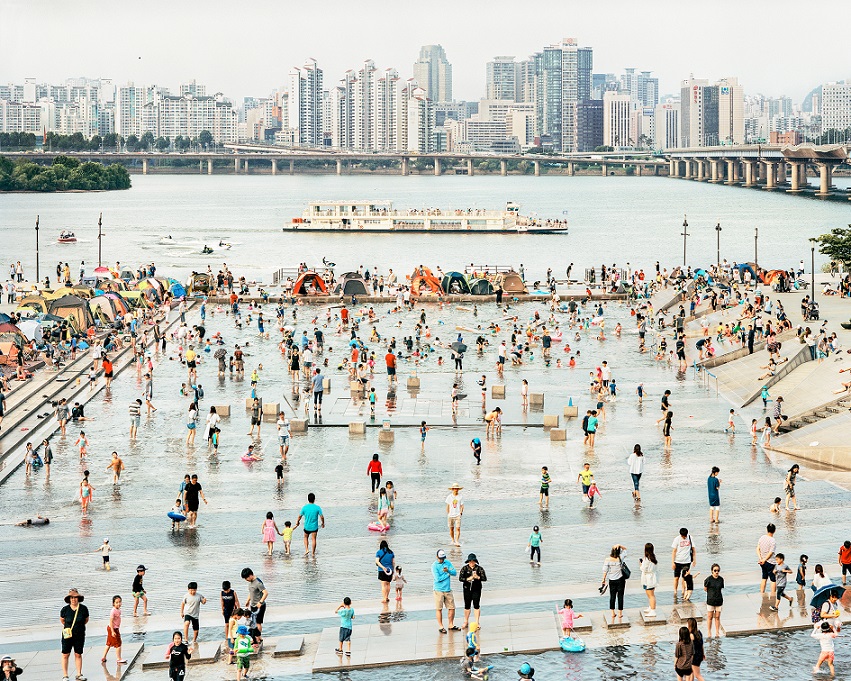
Mulbit Square is a water playground in Hangang Park, reachable by metro from Seoul.
For families with small children, it functions as an escape from the compacted housing blocks on the horizon.
The juxtaposition of people in the foreground, confined to an allotted space of water, the elevated highway and the tower blocks makes for a composition of regulated life.
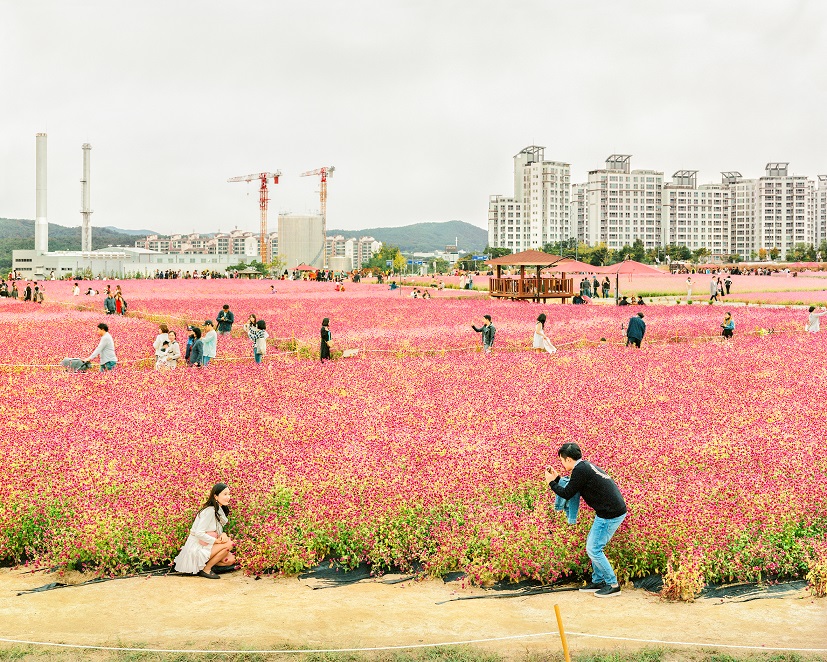
Major autumn harvest celebrations, Chuseok, are rooted in an agricultural way of life that is now foreign to most South Koreans. Held across the country, they hark back to a time when different regions had their own cultural identities. One such event is the Globe Amaranth Festival, held annually around a patch of land adjoining a factory and housing blocks. People attend to take photographs in a floral setting.
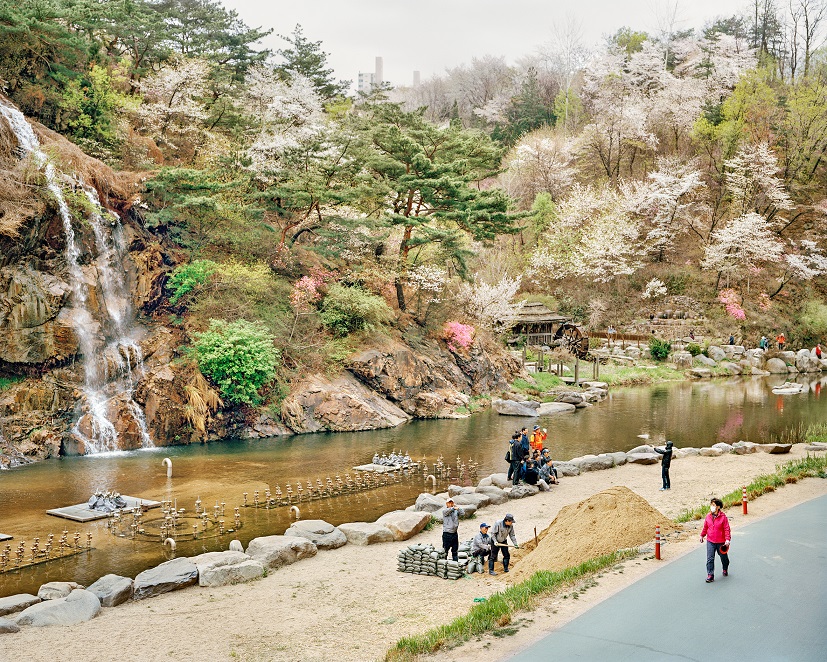
A tributary of the main river that runs through Seoul, Hongje Stream, has been landscaped to imitate a classic Korean landscape of cherry trees and waterwheels, with an artificially created waterfall and fountains added to finesse the illusion of tranquillity.
Kim’s photographs, using large format film, are carefully composed and executed.
He writes of seeking to observe human society “at a distance from the realm of technology… a worldview in which humans are the main actors.”
The sentiment is worthy but wishy-washy and his photographs reveal people not as ‘main actors’ but as figures in a landscape.
One imagines, when leisure time is over, a return to a world of work where life-substances can be fed into a “Matrix”-like machine feeding off their energy and reducing them to passive prisoners in a prenatal fluid. Kim’s camera is the gaze of a panopticon, dispassionately observing, and nowhere is there a hint of the liveliness of leisure time as portrayed by Brueghel.
“Better Days”, by Seunggu Kim, is published by Kehrer.
(Photos supplied by the publisher)










.jpg)












