
Henri Bergson was an intellectual celebrity who received a Nobel Prize but then sank into relative obscurity. Three new books signal the renewal of enthusiasm for a thinker who was once the most famous philosopher in the world.
 Sean Sheehan
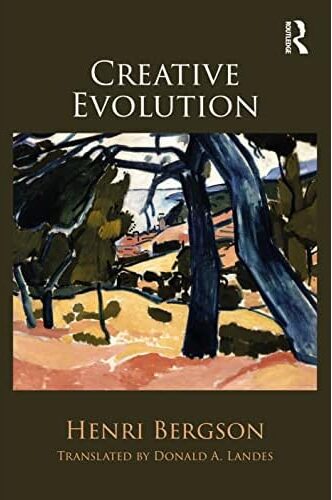
With “Creative evolution” (1907), Bergson’s fame ‘skyrocketed’. This is how Emily Herring puts it in her engaging biography.
She notes the coincidence of his birth in the autumn of 1859 and the publication of Darwin’s “On the origin of species”, a book that shattered belief in the notion that God created the world in six days.
The process of evolution cannot be doubted and Bergson was never in the camp of fundamentalist Christians when he questioned a mechanistic understanding of the world that ignored what he called élan vital (‘vital impetus’).
The notion of a creative life force that cannot be crudely reduced to the material only becomes mushy when it acquires mystification and Bergson avoids this. Lived time as duration (durée), not calculable as numerical time, is about becoming as opposed to being, and Bergson emphasised this. He makes intuition a complement to instinct, knowing that brain processes themselves cannot explain the mind’s self-awareness. Intuition, as the superb introduction to “Creative evolution” puts it, “is the capacity to connect, from within oneself, through a kind of sympathy, with the inner orientation of things, of species of life itself “. (It is, after all, the best reason for going vegan.)
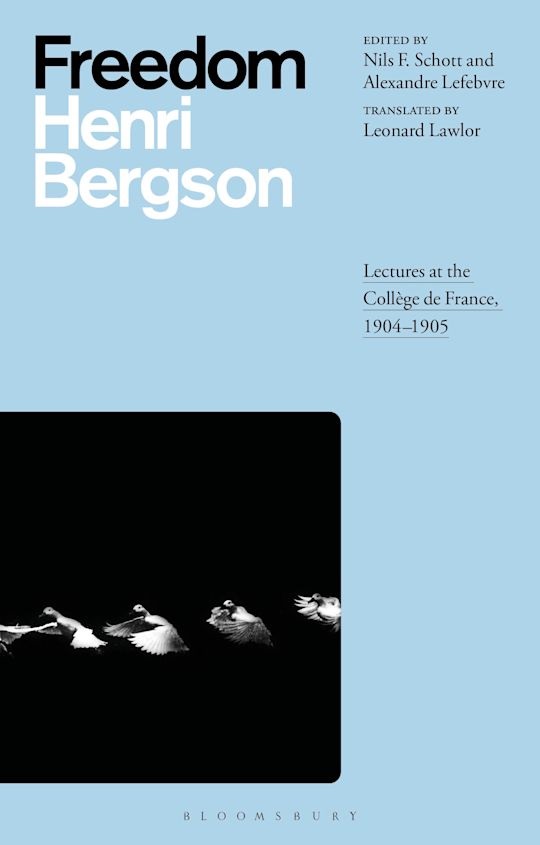 Weekly lectures at the Collège de France by Bergson were hugely popular, reflecting his belief that philosophical ideas could be explained in everyday language.
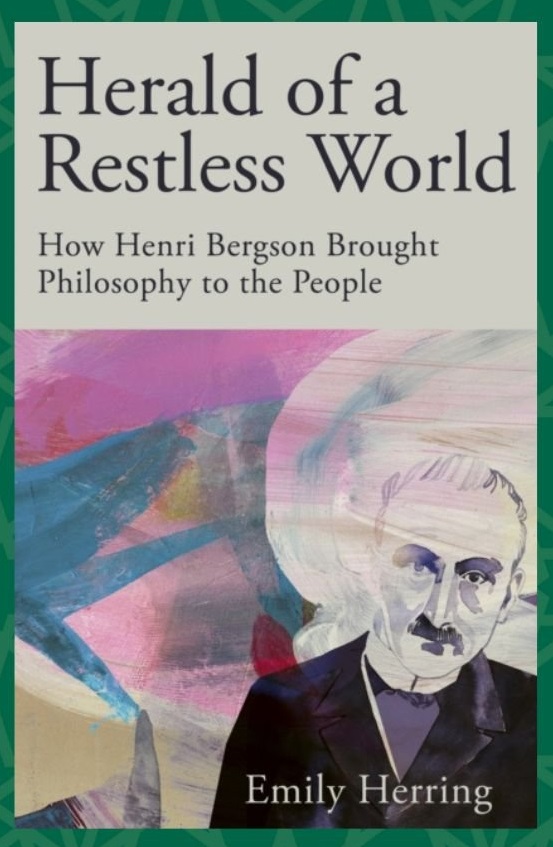
Hence Emily Herring’s subtitle for “Herald of a restless world”, her biography: “How Henri Bergson brought philosophy to the people”.
Herring’s vivid descriptions of how the lectures were delivered and received are typical of a writing style that brings to life scenes and moments from the experiences of someone who looks dry as a stick in photographs.
Bergson’s deft ability to communicate ideas about the nature of time and the possibility of freedom is on show in “Freedom”, a translation of his 1904-5 course at the prestigious Collège de France.
Our freedom as agents is a facet of intuition and it exists in a space outside of the normal run of causes and effects.
 He traces the development of this idea back to the ancient Greeks and applauds how Plotinus, himself a Greek, brought together their insights.
He cites the image from Plotinus comparing the material universe with dance: the dancer is not conscious of all their complex movements, s/he just wants to dance.
The dancer intuits their freedom and Bergson links his philosophy of freedom to the nature of human life.
“Creative evolution” by Henri Bergson, is published by Routledge. Bergson’s “Freedom: Lectures at the Collège de France” is published by Bloomsbury. “Herald of a restless world: How Henri Bergson brought philosophy to the people”, by Emily Herring, is published by Basic Books.










.jpg)












