
The three parts of “The aesthetics of resistance” by Peter Weiss were published between 1975 and 1981 in German. The first English translation of Volume I appeared in 2005, the second volume fifteen years later and now the final part is available.
 Sean Sheehan
Between them, the three volumes cover the period from the civil war in Spain (1936-9) to the end of World War II in 1945. Real events and individuals who took part in them blend with a fictional narrative and a glossary is provided at the back of the book to help the reader.
Volume III is not an easy book to read but the rewards are tremendous. There are no chapters dividing up its 267 pages and precious few paragraphs either.
Sentences are long and sometimes convoluted – the translator is not being capricious but giving voice to the prose style of the original German text. This, ideally, is a book for a reading group where the story and its themes can be discussed and mulled over.
The volume begins in May 1940 and the narrator introduces a family who have settled in Sweden after fleeing from Bohemia, part of the ‘great wandering’ of people in the wake of the catastrophe overtaking Europe. The mother, traumatized by the executions she witnessed and from which she barely escaped with her life, has stopped talking and her escape into silence represents one way of responding to the horrors unfolding around her. When a gay friend commits suicide the act provokes thoughts about her personal entanglements as well as the wider world of arbitrary power and the sacrifices of the many for the few.
World War II has begun and despair, it might seem, is a rational response to what is taking place.
 Another response is to resist and fight back and this becomes the main narrative thread as a small group of communists in Sweden plan returning to Nazi Germany in order to organize opposition to Nazi rule.
Their loyalty to Bolshevism is challenged by Stalin’s pact with Hitler (1939-41).
The reader shares the tribulations of Charlotte Bischoff (1901-1994) as she prepares to travel illegally to Germany, disguised as a sailor on a merchant vessel.
Her journey is successful but many of her comrades are eventually betrayed and captured by Nazis. They can expect no mercy and face execution.
All three volumes of “The aesthetics of resistance” raise questions about how to resist in unholy times and the reader is drawn into the debate. What happened in Spain and Germany in the 1930s has its own history but what is now taking place around the world cannot help but evoke the calamities and upheavals of those times.
 The descent into madness of the mother who figures at the beginning of the book is emblematic of the despondency now threatening to plunge us into political suicide.
The author, Peter Weiss, never gave up the struggle and nor should his readers.
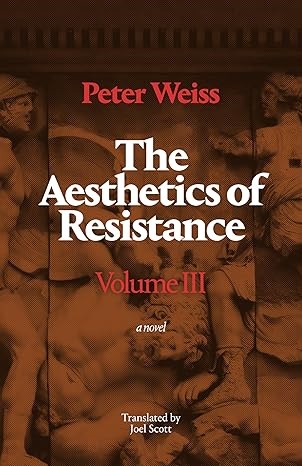
“The aesthetics of resistance Volume III”, by Peter Weiss, translated by Joel Scott, is published by Duke University Press.
(Photos: Pixabay)










.jpg)












