
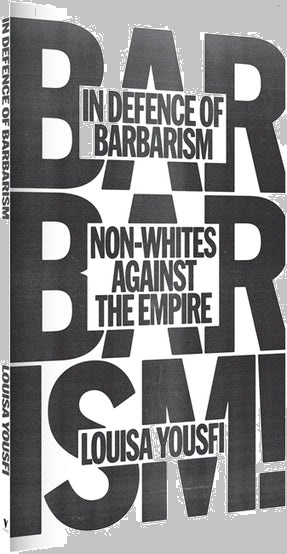
In last week’s The Prisma, Claudio Chipana Gutiérrez made the case for positive forms of identity and Louisa Yousfi in “In defence of barbarism: Non-whites against the Empire” does something similar by defending the value of barbarism.
 Sean Sheehan
Reading Kateb Yacine, the writer who came from the country her parents had left when they arrived in France as immigrants, Yousfi learned the importance of resisting “the language of the Empire’ and ‘the domestication of barbarians” that goes under the name of integration.
She is not embracing a narrow form of identity politics because the nostalgic sense of something left behind – a natural experience for immigrants – highlights the need to insist on the difference between barbarism and savagery. The savage is subjected to being civilized but the barbarian holds back something of their own: for Yousfi, this is “too much France, too much Empire”.
After the terrorist attack on the offices of the satirical magazine Charlie Hebdo in 2020, “Je suis Charlie” (“I am Charlie”) became a rallying cry for a narrative that saw the attack as an assault on the enlightened values of the Empire, “its zest for life, for dancing, for drinking, and for loving”. Yousfi rejects this posture and points to the blithe disavowal of the violence of the West that produces a violent extremism of its own. In “Zero Point”, Źiźek makes a similar point about the attack by Hamas on Israel in October 2023.
One of the strongest chapters in “In defence of barbarism” illustrates Yousfi’s position by way of the life and music of the rapper Élie Yaffa, who goes by the name Booba. She describes him as “the West’s worst nightmare: at once the embodiment and the repudiation of its racist fantasies”.
 By refusing to succumb to “the sirens of Empire”, his rap language announces what it means to be non-white in France today and aligns itself with “pirates, UFOs, shadow warriors, fugitives from the Matrix”. Rap becomes emancipatory by taking language out of its comfort zone.
“In defence of barbarism” is about being black or Arab in France but the author’s message is readily translatable. Like Stephen Dedalus in “A portrait of the artist as a young man”, listening to an English priest and realising that he “cannot speak or write these words without unrest of spirit”, Booba rejects the language of integration and sets out to sabotage ‘its pretension to reflect a common identity’. The pretension is a lie in precisely the sense that Starmer in the UK speaks of the value of ‘diversity’ and then sets about endorsing the exclusionist mentality that barely disguises its racism.
 Feeding off the comfort of whites who, for their own immiseration and unhappiness, blame immigrants and refugees, Starmer’s Labour Party is like the machines in The Matrix harvesting humans’ bioelectric power.
Louisa Yousfi is writing her first novel and if it proves as defiant as her non-fiction the waiting will be worthwhile.
“In defence of barbarism: non-whites against the Empire”, by Louisa Yousfi, is published by Verso.
(Photos: Pixabay)










.jpg)












