
The first insurrection against the British Empire in the twentieth century, the Easter Rising, took place in Ireland in 1916 – when the Empire controlled nearly a quarter of the world’s population.
 Sean Sheehan
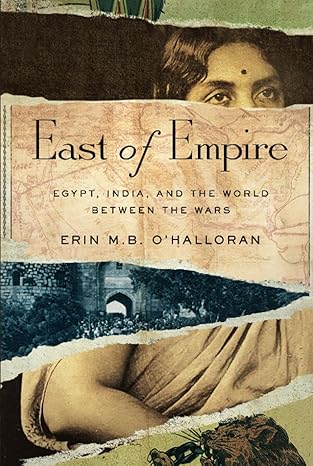
Nationalist and anticolonial resistance spread widely in the aftermath of World War I, especially affecting Arabs and South Asians, and this is the subject of “East of Empire”.
The most important city in this story is Cairo. For Arabs, it became a centre for those working to throw off the shackles of foreign rule and for the British it was crucial for the defence of the Suez Canal, the vital connecting link to imperial possession of India. Cairo was the media capital for the Arab-speaking world and for much of the Asian continent; it was the epicentre for the colonial bonds that brought together Indians, Egyptians and other Arabs in a common struggle. This was not the affinity grouped under the concept of Orientalism – the foreign place of the Other – but a riposte to such an imperialist notion.
“East of Empire” locates this riposte in a sphere where different ideas and ideologies overlapped – and not just narrowly anticolonial ones. The author begins with the Egyptian Revolution of 1919 which delivered quasi-independent status while Britain kept control of defense and the Suez Canal. A more severe challenge in the 1920s came from Hindus and Muslims joining forces to rock the foundations of Empire.
 Two chapters are devoted to Palestine – under a British mandate since the end of WWI – beginning with the 1936-39 Arab Revolt and, as the author outlines, the murderous response of the British ‘in close coordination with local Jewish militias’. How Egyptian and Indian activists were affected is closely covered in the book and ‘The Feminists’ chapter draws attention to prominent women, like Kamaladevi Chattopadhyay.
The outbreak of WW2, a war between fascists and imperialists in Europe, posed problems for the anticolonial East. Ghandi was unsure how to respond while many of his colleagues saw opportunities to depose their colonial masters by siding with Germany. Such reasoning was shared by others across the Middle East. Egypt had to cede control to the British but there was unrest caused by economic stringencies. Tens of thousands of refugees fleeing Europe made their way to North Africa and the Middle East and it looked as if Cairo would fall to Rommel’s desert army.
The dramas of the war years affecting Arabs and Indians are adroitly unpacked in “East of Empire” and make compulsive reading. The epilogue comes with the partition of India into Hindu and Muslim majority states – displacing over 10 million people and causing the murder of a million more – and partition in Palestine with its own disastrous consequences.
 These matters and their origins in Empire are quickly skirted over by O’Halloran, outside the brief of a valuable historical study about ‘dreams and plans envisioned but never quite enacted’.
“East of Empire: Egypt, India, and the world between the wars”, by Erin M. B. O’Halloran is published by Stanford University Press.
(Photos: Unsplash)










.jpg)












