
If Herodotus is the ‘father of history’ then surely Strabo (c. 60 BC–c. AD 25), describing the physical past and present of his known world, deserves the same status for geography.
 Sean Sheehan
Born more than half a millennium after Herodotus, Strabo documents three continents at a time when Rome was assuming and extending its imperial role over this world. His own birthplace, now Turkey, had already fallen to Roman domination and so too had Egypt where he went on to live and write his magisterial Geography.
Strabo shares with Herodotus a tremendous curiosity about places and cultures that are not his own. He observes people practicing yoga, seeing it as a test of ‘endurance’ (true), and is impressed by ‘a sort of stone’ (asbestos) on the Greek island of Euboea that is combed and woven into hand towels which are cleaned by being ‘thrown into the fire and cleaned of their filth as if by washing’.
These examples were found with the help of one of the indexes at the back of a stupendously wonderful new edition of Geography. In this index, a selection of topics and themes, you find entries as varied as Amazon women, colonial plunder by Romans, homosexuality, old age and death. In a work so sprawling, the index is a better way of becoming acquainted with the writing than starting at the beginning and ploughing through a thousand pages and a quarter of a million of Strabo’s words.
Just how encyclopaedic the Geography work is finds reflection in the longer index of ancient places and people that takes up nearly 80 pages of small print.
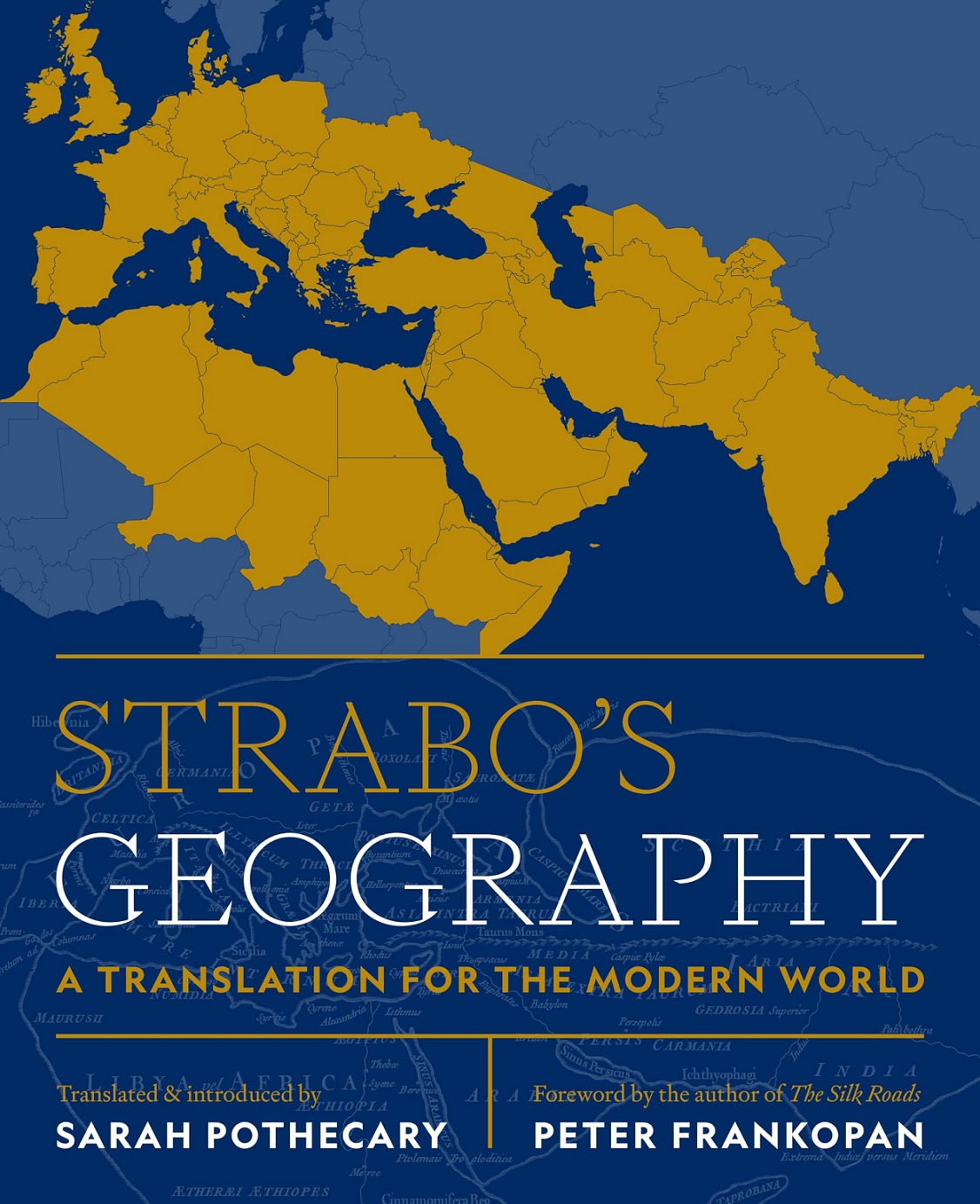
A third index, “A directory for the modern reader”, further facilitates reading the narrative by way of familiar names : places like Crimea and the Gaza Strip as well as the limits of his known world: Bangladesh (east), Portugal (west), Arctic and Antarctic (north), Somalia (south).
Sarah Pothecary’s organization of the text, her translation, explanatory notes and references in the wide margins and her indexes constitute a mighty labour of scholarly love and she deserves mega congratulations for seeing it through and completing a work that must have taken a number of years. What may have helped sustain her in the task are Strabo’s own words near the beginning of his enterprise:
He who is familiar with neither a straight line versus a curved one, nor a circle…who is not cognizant of the seven stars of the Great Bear in the night sky not anything else of this sort…has not need of this work, or not now, not until he reads up on those matters lacking which he is not suited to geography
It would be insulting to call Pothecary’s edition a coffee-table book but it does need to be kept ready-to-hand, to dip into and become engrossed. Having a copy is an investment for a lifetime of reading.
“Strabo’s Geography: A translation for the modern world”, by Sarah Pothecary, is published by Princeton University Press.










.jpg)













