
Modernism was a renaissance in the early twentieth century affecting different art forms around the world. Not coincidentally, it arose from the ashes of the destructive conflict of imperialist powers that produced World War I.
 Sean Sheehan
Modernism is not to be conflated with modernity and its dustbinning of tradition, fetishizing of the New and wallowing in the fact that, as Bob Dylan puts it in “Visions of Johanna”, we sit stranded here while doing our best to deny it.
Many modernist writers, like T. S. Eliot and D. H. Lawrence, looking back to myths and a mythical past where life was organic, sought to rescue forms of subjectivity from the past that could replace failed ones of the present.
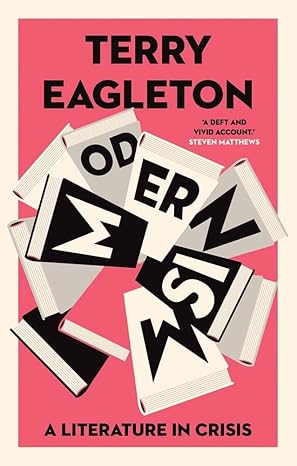
Terry Eagleton’s account of modernism, concise and incisive, focuses on its literary manifestations in British culture without forgoing its European dimension and the way it played out in post-colonial societies. Eagleton excels at summarising without being reductive and this is shown at its best in the pages he devotes to Irish modernism and its own set of causes. Modernism interrogates its own forms – for literature this means questioning language itself – but the Irish language had been almost erased by colonialism and the Famine. Writers like Joyce and Beckett were using a language not entirely their own, something they shared with the émigrés and expatriates “plunged into the polyglot babble of some Parisian café, Viennese studio or Zurich cabaret”.
 Literary modernism suspects the Word and resists assuming that language mirrors reality itself. “Exile and denaturalisation go together”, as the author neatly puts it, and much modernist art arises from a sense of internal exile.
He rejects completely the idea that this gives credence to the postmodernist position that feeds contentedly off a presumed superiority and a conviction of cultural relativism that allows for irony about all values.
Marx, in early pages of “Capital” (1867), saw how the value of a commodity is not created by its own material qualities but by its ability to exist in a network of commodity exchange governed by the amount of labour-power going in to its production. A modernist work looks to be autonomous and, by being uniquely concerned with its own poetic materiality, can be seen to avoid the status of a commodity.
 Modernist art aspires to exist outside the exchange network but in doing so becomes itself a kind of fetish and yet fetishism is what Marx associated with the commodity form.
Modernism is thus caught in a dialectic which questions its identity and makes it ambivalent.
This shows itself it also in the way some modernist writers, such as W.B. Yeats and Ezra Pound, were deeply conservative, yearning for hierarchy and order, but at the same time boldly original. Eagleton, alert to rash generalizations and simplistic explanations, is a tonic for lazy thinking and his new book Modernism is an intelligent and lively overview of the twentieth century’s artistic revolution.
“Modernism: a literature in crisis” by Terry Eagleton is published by Yale University Press.
(Photos: Pixabay)










.jpg)












