
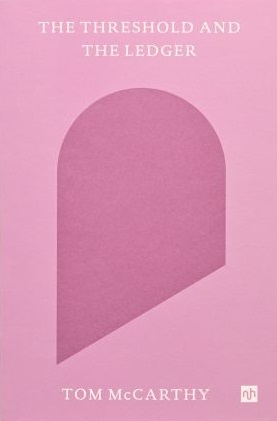
What it means to have a home has been central to drama, poetry and the novel for millennia. It is explored with insight by Tom McCarthy in a scintillating piece of literary analysis called “The threshold and the ledger”.
 Sean Sheehan
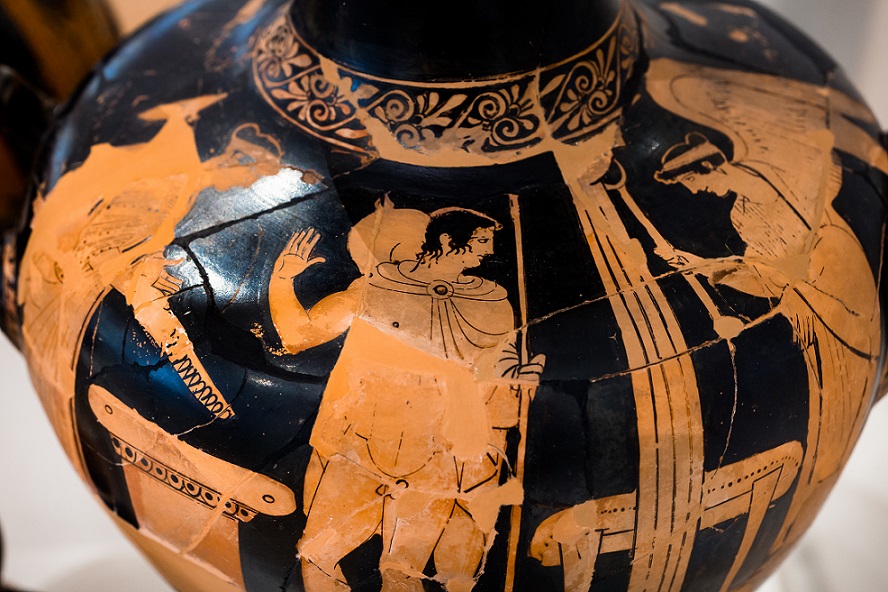
The home/house as both a place of shelter and of strife is a core theme in ancient Greek tragedy. Aeschylus and Sophocles build many of their dramas around it and, for Aeschylus, the House of Atreus is a nest of crime, incest and infanticide. Cassandra, brought home as a trophy after the fall of Troy, intuits and gives voice to this. She operates, as McCarthy artfully puts it, on a kind of ‘liminal wavelength’ that makes her aware of Agamemnon’s imminent murder by his wife when he steps onto the crimson cloth that she has laid over the threshold of their house.
When Agamemnon crosses the threshold, less a boundary and more a point of transition, revenge is inflicted on him by his wife for his willingness to sacrifice their daughter, Iphigenia; something he did in order to placate the winds preventing the Greek ships from sailing to Troy.
The course of journeying from the inside of home to the outside and then back again– marking Odysseus and Oedipus as well as Agamemnon – is fraught with consequences and McCarthy traces its recurrence in David Lynch’s “Lost Highway”. In the movie, Fred Madison’s journey from his home is an unravelling of his psychic safety and the homeliness of his married life descends into a place of the unheimlich (‘unhomely’).
The psychotic journey away from the safety of the home/house can also be an ecstatic one, in the literal sense of the ancient Greek ec-stasis, standing outside. This is looked at by McCarthy, with the aid of the classical translator and poet Anne Carson, in relation to Shakespearian comedy. In Twelfth night, the thresholds that are crossed are ones of identity, gender and sexuality.
The excursions into Aeschylus, David Lynch, Shakespeare (and Kafka) are triggered by lines from a single poem by the Austrian writer Ingeborg Bachmann (1926-73) called ‘Salt and Bread’ (a translation of which forms an appendix to “The threshold and the ledger”). Bachmann is most famous for her novel “Malina”, a compelling work that charts the narrator’s struggle with two male figures: a man she is in love with, Ivan, and her elusive flatmate Malina (whose actual existence is questionable). The struggle is played out in spaces within and outside the narrator’s house and, by extension, the House of Austria which mirrors the House of Atreus with its horrors and crimes that reach out and connect with the country’s Nazi’s past.
 “The threshold and the ledger” is only 72 pages in length but, written with clarity of expression and compression of informed thought, is bound to drive the reader to the short bibliography of authors he discusses so skilfully.
“The threshold and the ledger”, by Tom McCarthy, is published by Notting Hill Editions.










.jpg)













