
Far-right narratives are increasingly exploiting violence against women and girls to scapegoat migrants and deepen social division, organisations working with survivors warn. A new guide aims to help people identify and challenge the misinformation behind these claims.
Pablo Muñoz
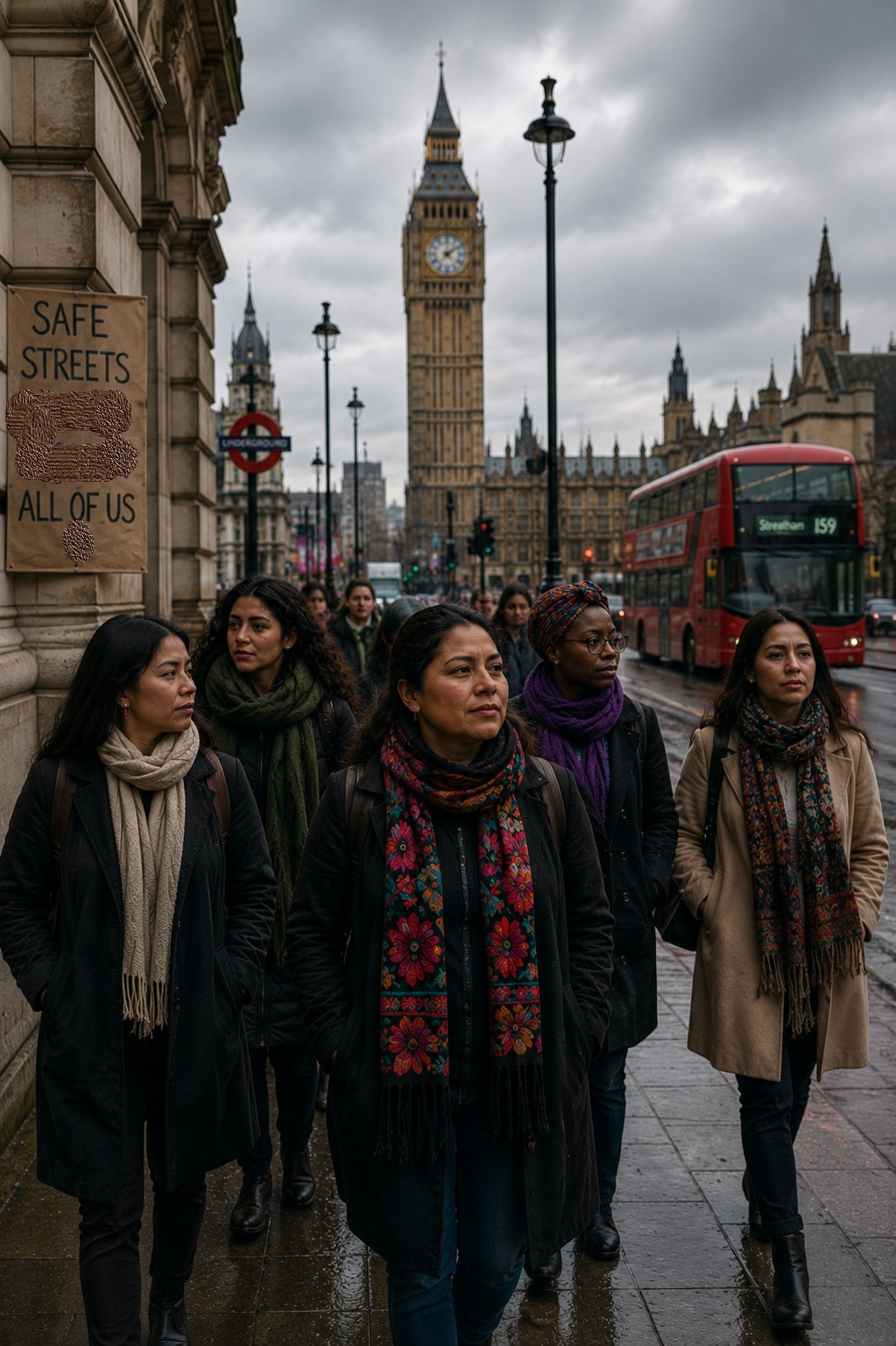
On Saturday 13 September last year, a “unite the kingdom” rally was held in London. There, Stephen Yaxley-Lennon, also known as Tommy Robinson, claimed that “British women and girls “are scared to walk the streets”. As he put it, their safety has been taken from them, adding that communities are crumbling “at the hands of open border, mass uncontrolled immigration”.
The correlation he attempted to make between immigration and sexual assault crimes against women and girls is conspicuous and showcases a trend in political rhetoric that transcends frontiers.
Just last November, Santiago Abascal, the leader of the Spanish far-right party VOX, proposed 24 new measures that aimed to guarantee freedom from violence against women. Six of these measures include references to foreign individuals, and one explicitly calls for the end of “open-border policies”.
The traction these narratives have received online has made them more and more mainstream, and as such they are now enshrined in the social conversation. Back in August 2025, more than 100 women’s rights groups sent a letter to Prime Minister Keir Starmer, and Yvette Cooper, the then Home Secretary, warning about the “dangerous racist diversion” that is linking sex offences with migration.
This letter was the catalyst for End Violence Against Women Coalition, Hibiscus, Southall Black Sisters, Latin American Women’s Rights Service (LAWRS), Women for Refugee Women, Asylum Matters and Imkaan, to come together to create a guide that intends to provide the tools to challenge and counter misinformation surrounding the weaponisation of violence against women and girls (VAWG) for political gain.
The guide launched last April and called Not in our name, states that it exists because “the right” is using the “shrinking opportunity, agency and hope” of today’s economic circumstances as a fertile ground for division. They say that “they’re using violence against women and girls as a powerful weapon”. As such, they argue that language used around this issue is important.
 LAWRS spoke to The Prisma. In an interview, they say the guide was intended to help anyone who might find themselves challenged with misinformation on anti-immigrant rhetoric involving VAWG, and that “the objective is to provide people living in the UK and elsewhere with accessible tools that would enable them to question disinformation and divisive narratives in day-to-day life”.
Latin Americans lack official recognition in the UK census. According to LAWRS, this invisibility has to do with the fact that Latin-Americans “are not considered an ethnic minority” in the UK. Some councils recognise the Latin American population -like Southwark, Lambeth, or Islington councils in London, but others do not. “It is necessary for this criterion to be standardised,” they say.
It is LAWRS’s position that better data representation and greater visibility of the needs and experiences of Latin American women who suffer from VAWG would contribute to a greater understanding of the tools needed to protect this demographic group in the UK.
As a member of the Coalition of Latin Americans in the UK (CLAUK), which is trying to have “Latin American” recognised as an ethnic group in the UK data collection, including the 2031 census-, LAWRS supports Latin American ethnic recognition in the census.
What the organisation points out is that they had first-hand experience of how violence against women has become a scapegoat.
 “The moment there are problems in politics or economics, VAWG is used against migration,” they added.
They add that these “problems” mentioned are “linked to structural barriers and the prolonged consequences of austerity policies”. The use of VAWG to turn the focus onto immigrants rather than these structural issues in society is, in LAWRS’s eyes, “feeding social division and being used to justify hostile migration policies, racist abuses, and far-right narratives”.
“These narratives,” LAWRS clarifies, “rarely include the voices and experiences of racialised and migrants victims and survivors in the UK, even if they are disproportionately affected by VAWG and face important systemic barriers to accessing help and support.”
This negatively impacts Latin American women who are victims of VAWG in the UK because, as a spokesperson for LAWRS puts it: “If there exists an anti-immigration narrative within the public, there won’t be a situation of comfort or confidence on institutions when the time to report a crime comes.”
LAWRS mentioned the riots in Southport and Epsom to illustrate how “through the media, and through political speeches” narratives that were “extremely radical against immigrants and asylum seekers” create a “foundational structural problem”, because they blame migrant men while leaving “migrant women without support when they are in situations of violence”.
 As stated in the guide, Not in our name’s target audience includes people of all backgrounds, but it also aims to reach “campaigners and communicators, frontline and community workers, and journalists”.
Some members of the latter group, alongside other media professionals, have “shared positive comments on the guide”, explains LAWRS. However, its quantitative impact cannot be measured yet, as the guide was released only two months ago. Thus far, they have not observed any public reaction to Not in Our Name by any far-right groups. The guide, which was written by Kathryn Quinton in cooperation with the seven groups that got behind this initiative, was not in itself a response to a specific study or data set. Instead, it originated from the first-hand experience of these organisations, which closely work with migrant women and survivors of VAWG, as well as from observing the tangible political rhetoric that uses migrants as scapegoats, and VAWG as a tool.
A spokesperson for LAWRS thinks that “violence against women is not a tool; it is not a justification”. “Violence against women is not an isolated incident, or something that happens just within certain communities, but a generalised problem.”
To read the full guide click here.
(Photos: Pixabay)










.jpg)












