
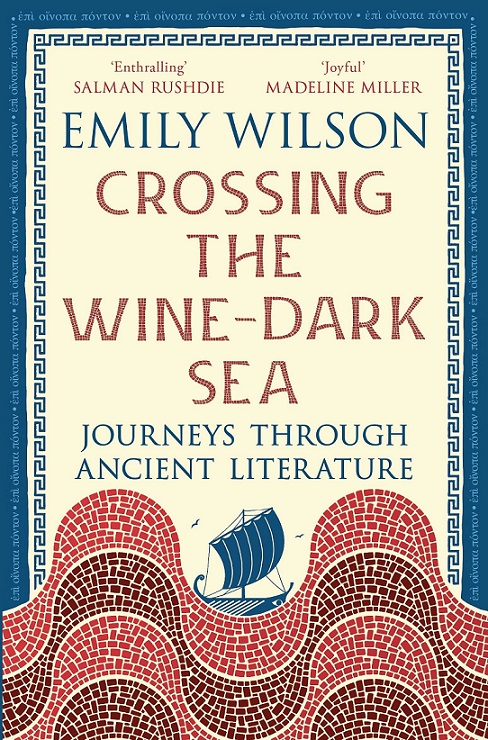
Emily Wilson’s verse translations of Homer have been justly acclaimed and a new collection of her reflections on ancient literature, in “Crossing the wine-dark sea”, are welcome reading.
 Sean Sheehan
Looking at the poetry of Sappho and how it has been received over the centuries, Wilson resists the too easy assimilation of her as a feminist, gender-bending icon. She prefers to rely on the slender fragments of her poetry that have survived, finding in them eloquent testimony to feelings of alienation and isolation. Helen of Troy, on the other hand, is a ‘construction of the Greek male investigation’ and born of its sexual anxieties.
Issues around translation are pivotal to these essays and, like the famous argument that, for a culture without snow, a phrase such as ‘white as snow’ would best be translated as ‘white egret feathers’, they will be of interest to anyone who reads in more than one language. (Wilson’s criticism of the dialogue in Nolan’s “Odyssey”, in the London Review of Books, is not a principled objection to rendering ancient Greek in modern American English but the boringly pedestrian prose that results.)
Wilson is writing for those absorbed by ancient Greek literature and society but without knowledge of the language.

She points out that the iconic status of ancient Greek democracy (itself primarily limited to Athens) was of short duration and was preceded and followed by centuries of undemocratic rule. Writing about the “Oresteia”, the trilogy of plays by Aeschylus, the position of women and resident aliens is raised – neither group having the right to vote in democratic Athens –when discussing the trilogy’s concern with questions around inclusion and exclusion, the power of rhetoric and the rule of law.
The contemporary relevance of this, whether from what is happening in Colombia or in the US, is painfully obvious.
Like a fair number of readers of ancient literature, Wilson is unmoved and intellectually disengaged from ancient Roman comedy but she warms to Catullus, “a poet of power, bondage, money and social class”. Astonishingly, we can only access his work because a single manuscript came to light in a monastery in Verona in 1300 and was copied twice before being lost again. Her essay “Chill out with the Stoics” is tremendously good, especially when it comes to Epictetus – though there really should be a reference to Marx here – and the potted account of Marcus Aurelius.
The popularity of Stoicism for our times and its appeal to business leaders who like to think of themselves as enlightened is deftly explained: “important people in business and tech are sometimes leery of the devoted, abject faith required by many monotheistic traditions” but Stoicism gives them the cake and allows them to eat it. Ancient literature has far more to offer than this and Emily Wilson points out some of the paths (and translations) worth following.
“Crossing the wine-dark sea” by Emily Wilson, is published by Profile Books.










.jpg)












