
Heidegger, despite his troubling allegiance to Nazism, is one of the most important philosophers of the twentieth century and a new translation of his classic text makes it more approachable than before for readers without a knowledge of German.
 Sean Sheehan
It has been said that reading Heidegger, in German or English, is like breathing through mud. This is a properly ironic comment given that he wanted to avoid traditional philosophical language because he thought it obscured the heart of important matters. The translator of the new edition, Cyril Welch, sets out to make “Being and Time” more accessible by not using the new German vocabulary that Heidegger deployed for many of his key terms.
The most crucial of these terms is Dasein – a word that is nowinseparable from Heidegger’s thought – and Welch translates it as ‘being there’ and (like other key terms) always refers to it in English. He only uses Dasein in German as one of the seven words whose meanings are discussed in a postscript to the translation; the term also appears in the Index of Topics at the end of the book. Adding to the apparatus for readers, there are different sorts of footnotes: Heidegger’s own notes and marginalia as well as the translator’s annotations.
Page numbers in the left margin of this translation refer to the page breaks of the original 1927 edition of “Being and Time” and, as these are also used in earlier translations, this makes it possible to follow references in the various guides and introductions to the text (the most useful being the “Commentary” by Hubert L. Dreyfus and “The routledge guide to being and time” by Stephen Mulhall).
 The big question that Heidegger addresses is the meaning of being. He is not asking about the existence of this or that particular thing but what existence at its most general means.
There is nothing abstract about being although its meaning might seem self-evident. Everyone, as Heidegger says in his introduction, understands utterances like “The sky is blue” or “I am happy”: this is because ‘we already live in an understanding of being’ – but what remains is the enigma that lies behind what seems so obvious.
Heidegger often refers to our ‘always already’ state of understanding, a state that we are born and reared into. This makes it difficult to conceptualise but it also holds out the prospect of being changed. Our understanding is the result of the interplay of subject and object and, unlike much of philosophy before Heidegger, the truth of one of these terms in not grounded in the other term.
 As humans we have a peculiar way of being in the world; things have significance for us and that is why the world is as it appears to us. Dasein is a happening, not an entity, we are thrown into it and we take a stand towards it.
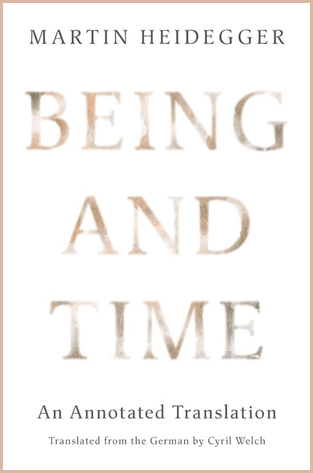
“Being and Time”, by Martin Heidegger, is published by Yale University Press.
(Photos: Pixabay)










.jpg)












