
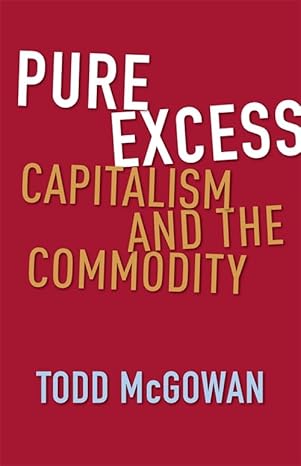
The author of “Pure excess: Capitalism and the commodity” does not go in for abstruseness. As with his earlier “Embracing alienation”, Todd McGowan unpacks and develops ideas from heavyweight thinkers, and explains them with a lightness of touch without sacrificing their depth.
 Sean Sheehan
The commodity, something bought or sold for various reasons, seems a fairly obvious concept to grasp but Marx wrote, in the first chapter of Capital, how when analysed ‘it is very intricate, full of metaphysical quibbles and theological quirks’. Inspired by this insight, McGowan runs with it in the company of psychoanalytic ideas and delivers some heartfelt and convincing insights into why always buying stuff is bad for our mental, physical and political health.
The content of a commodity, the stuff itself, is not to be confused with its form which is the promise of plenitude, the filling in of the lack at the heart of our being. For the economic system of capitalism, plenitude means overproduction, a going beyond what is necessary for us or the system itself. The result is an infection in our minds that seeks pure excess, unlimited accumulation. Satisfaction ultimately depends on not having everything.
The Marxist concept of commodity fetishism conceals unequal relationships between people. We work to produce commodities but any surplus profit is not shared and this is hidden when the commodity becomes a fetish and is worshipped as an object with a non-material quality. At one level, we know this is magical thinking but in our behaviour act otherwise.
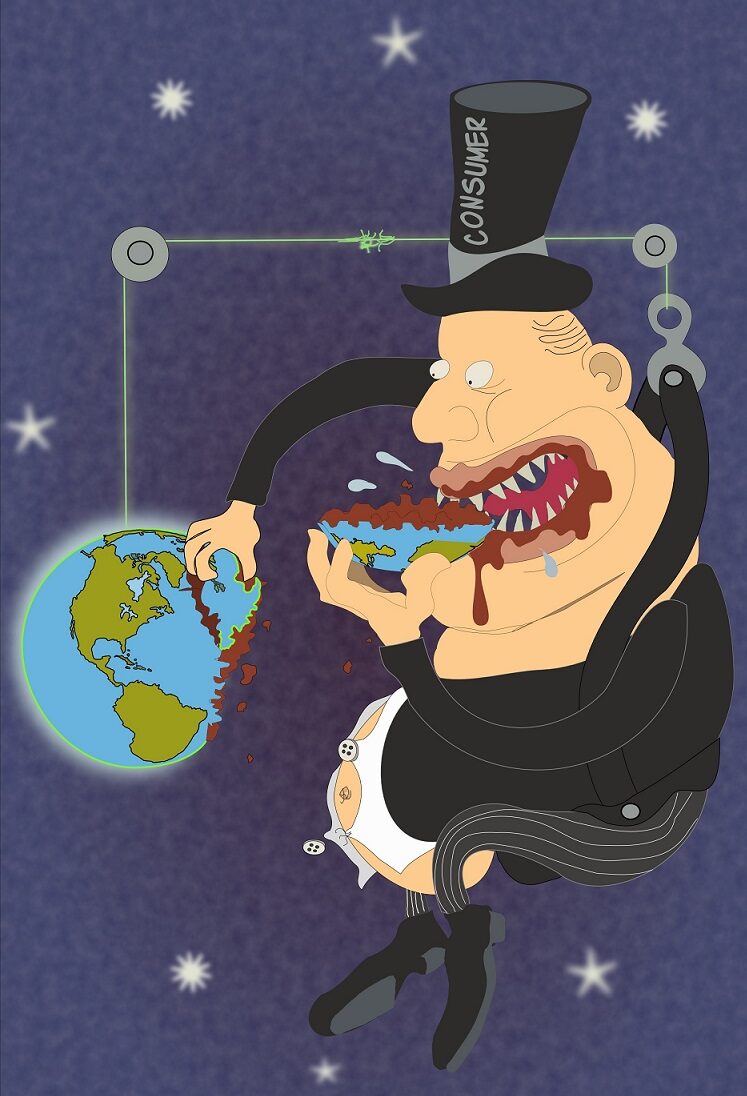 Advertisements for cars transport us into a fantasy world of open roads and the good life via the vehicle’s always-improved gadgets. People willingly fall for this because of what Freud called fetishistic disavowal, the denial of lack by believing in something or someone that is not subject to the loss of wholeness.
Whether this be the next iPhone model coming on the market, or whatever, what will be effaced is the labour of those who produce it.
The commodity becomes sublime when it displays some part of itself that serves no purpose, like a prestigious brand name. Religion profits by appealing to what capitalism cannot deliver, not the prospect of eternal life – who really wants that? – but the enjoyment of a useless activity, like going to church or praying: ‘Evidence that God doesn’t exist adds to the enjoyment that accompanies the leap of faith’ and for McGowan this creates an excess.
McGowan’s book excels with examples, like the 2019 movie “Us” and the 1993 “The piano”, or the way the collector, seeking another item for the pure sake of the set, does not act like a capitalist or consumer.
 Art (not the commodified art of the art market) is capable of resisting the commodity form and this is illustrated through the novels of Virginia Woolf which open the reader to ‘a logic that counters that of constant accumulation’, a logic that is available to all.
“Pure excess: Capitalism and the commodity”, by Todd McGowan, is published by Columbia University Press.
(Photos: Pixabay)
<










.jpg)












