In the face of the economic and digital power of the right, the Brazilian president achieved a seemingly improbable victory. His journey of political endurance and the mobilisation of millions of citizens on the streets and on social media resulted in a collective triumph that transcends Brazil’s borders and renews democratic hope in Latin America.
 Luiz Inácio Lula da Silva’s is a victory of extraordinary dimensions. No other Brazilian politician has secured the presidency four times or managed to win the run-off after coming second in the first round.
The result against senator Flávio Bolsonaro cemented an achievement that a few weeks before the presidential election seemed unlikely; but, if anyone could do it, it was Lula, whose story is built on impossibilities.
The metalworker who emerged from the working class to become president of the largest Latin American economy has again shown an exceptional ability to interpret popular aspirations, endure adversity and rebuild a majority when the horizon seemed cloudy.
His journey has been, in itself, a succession of extraordinary events: a union leader during the struggles for democracy, founder of the Workers Party and victor in the 2002 elections, he governed Brazil for two consecutive mandates between 2003 and 2010 with an international profile that turned him into one of the left’s most recognised figures on the world stage.
Then imprisonment arrived in 2018, removing him from the political arena. He spent 580 days in prison before regaining his freedom, while the verdicts against him were subsequently annulled by the Brazilian justice system.
When many considered his career over, he returned to the ballot and defeated Jair Bolsonaro in 2022 and now, on the eve of his 81st birthday on 27th October, he is writing another exceptional chapter.
After finishing behind Flávio Bolsonaro in the first round on 4th October, he managed to reverse the result and won his fourth mandate in an election that again mobilised a deeply polarised country.
However, this victory, in which Lula obtained 51.79% of the valid votes, against 48.21% for his rival, cannot be explained only by the figure of the leader.
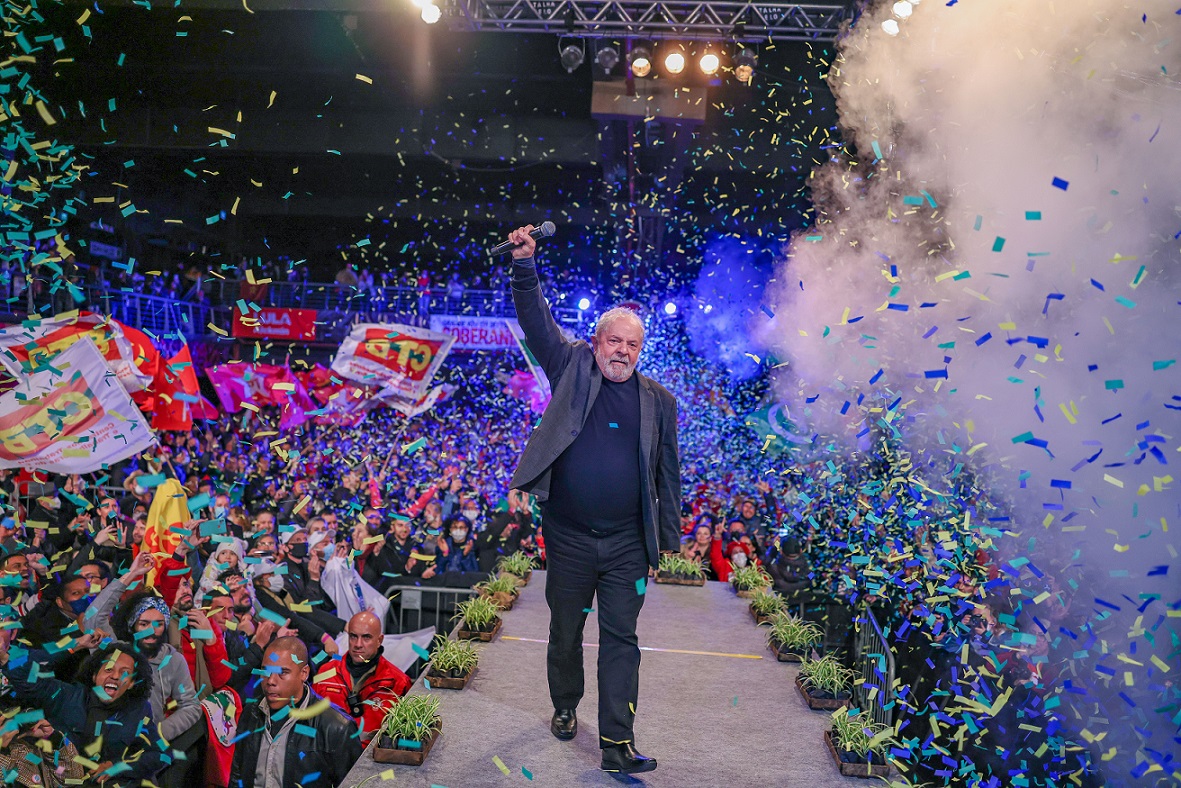
It also belongs to the millions of Brazilians who filled the streets, took part in events, shared messages and turned the campaign into a collective mobilisation.
The comeback had in social media one of its most decisive settings. The so-called Lula’s Army, organised on WhatsApp by the parliamentarian André Janones, brought together almost 11 million members.
In that group Janones, turned into the digital troops’ “general” by his followers, promoted meetings, directed actions and contributed to multiplying the presence of messages favourable to the president.
The initiative showed how knowledge of algorithms, the dynamics of content circulation and organised participation can be put at the service of a political campaign. But Janones also summed up a fundamental lesson: social media, on its own, does not win elections; digital strength needs to meet the mobilisation on the streets.
And there the militants were found, alongside the social movements, the workers, the young and the citizens who made the battle for the nation’s future their own.
Lula’s victory is, therefore, that of a leader who has demonstrated a great capacity for political survival, but also that of a multitude who decided not to stay on the margins of history.

In conversations with the head of state’s followers, several common elements in this shared struggle are usually mentioned: the need to protect national sovereignty and beat the far right, the preservation of social programmes and the defence of democracy.
We are living at a moment when it is necessary to choose between democracy and the bolsonaristas, commented the Brazilian Ana Paula Caldas to Prensa Latina as she left a polling station in the Federal District.
In the same vein, Célia Chaves de Souza reminded everyone that the Brazilian people had to fight hard to win democracy in the period following the military dictatorship, and she expressed her fears that a Flávio Bolsonaro victory would threaten that and other social advances. For both of them, and for many other Lula followers, the head of state represents exactly the right way to tackle those risks.
So, as Brazil begins a new chapter of its democratic story, Lula is again showing that his journey still has room for surprises.
But this time, the achievement does not only bear his name: it also belongs to millions of Brazilians who mobilised to turn what seemed impossible into a collective victory. (PL)
(Translated by Philip Walker – Email: philipwalkertranslation@gmail.com) – Photos: Pixabay







.jpg)