Entertaining and erudite, Terry Eagleton is the most appealing writer on culture anyone could hope for, and he does not disappoint even on the subject of death.
Sean Sheehan
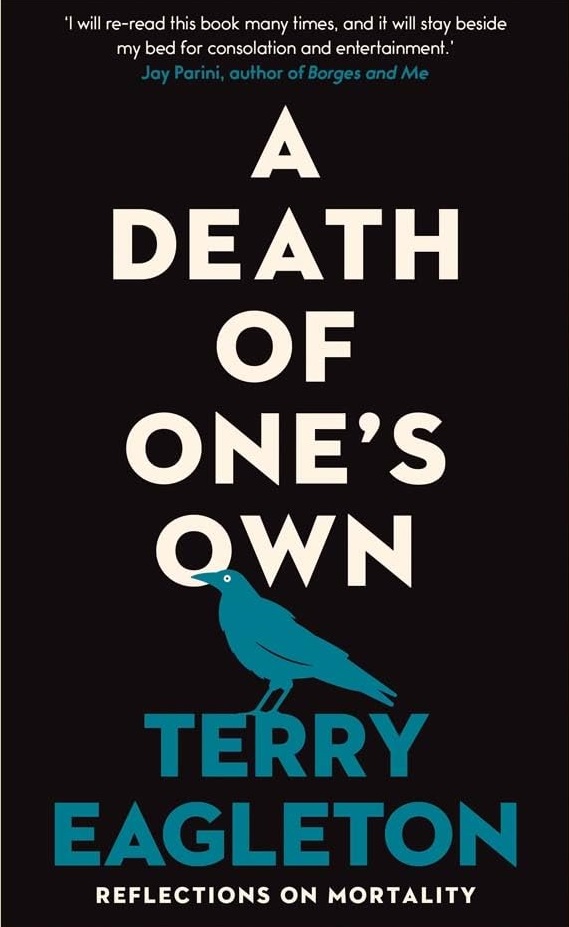
Eagleton’s inexhaustible reservoir of references and quotations, supplied by a lifetime of reading, spills on to every page of his latest book, “A death of one’s own”. Packed with memories, wry humour and aphorisms in his characteristically mordant manner, the book is a self-help guide to death and – ultimately more important – life.
Death, he writes, is a metaphor for life’s fragility, it teaches humility– probably not Jeff Bezos’s waking thought, he muses (nor Flávio Bolsonaro’s one might add) – and acceptance. ‘Beneath any particular sorrow lies the incurable bruise of being alive’, but death is the final therapy: the Duke’s observation in Shakespeare’s “Measure for measure” observes (Appointment in Samara could also have been referenced), that time spent trying to escape death is self-defeating since it only brings it closer, is Eagleton’s riposte to the very wealthy who consider themselves ‘too priceless to disappear’. A monastic attitude is commended but living in the shadow of death, so as to disarm it, and so too is the virtue of living as a militant who, unlike the liberal or conservative, knows ‘that the self is to be dismantled if it is thrive’.
 Ruth Ellis was the last woman to be hung in Britain, for shooting her husband after his repeated acts of violence against her, and the lesson gleaned from how she faced her executioner is one of the book’s many spiritual insights. Her spirit did not come from some eternal soul but from a body ‘a piece of matter that is expressive, productive, relational, communicative, self-determining, self-transformative and capable of unfathomably complex meaning’.
Wakes and the symbolism surrounding death can be helpful but not if they encourage the fallacy of thinking the dead are there in the graveyard: “There is nobody in the graveyard” (a convincing argument for cremation) and the Stoics had a point in embracing the inevitability of death as “the injury that will shield you from all harm”. None of this rescues us from the magnitude of the final and fatal absolute, the “mind-bending metaphysical” feat – he rightly calls it a stunt – of “slipping from something to nothing”. To add injury to the insulting effrontery of this, the prospect of everlasting bliss happening in a place called heaven just doesn’t cut it: “We want more than eternal joy”.
 In saying we all die alone, the we points to a “solidarity of solitude” that should unite us, but it does not redeem the grief our death may cause others who have to carry on without the comfort we might give them. It leaves Eagleton with a tragic perspective that is both personal and, his Marxist affiliations notwithstanding, political.
“A death of one’s own”, by Terry Eagleton, is published by Yale University Press.
(Photos: Pixabay)








.jpg)