
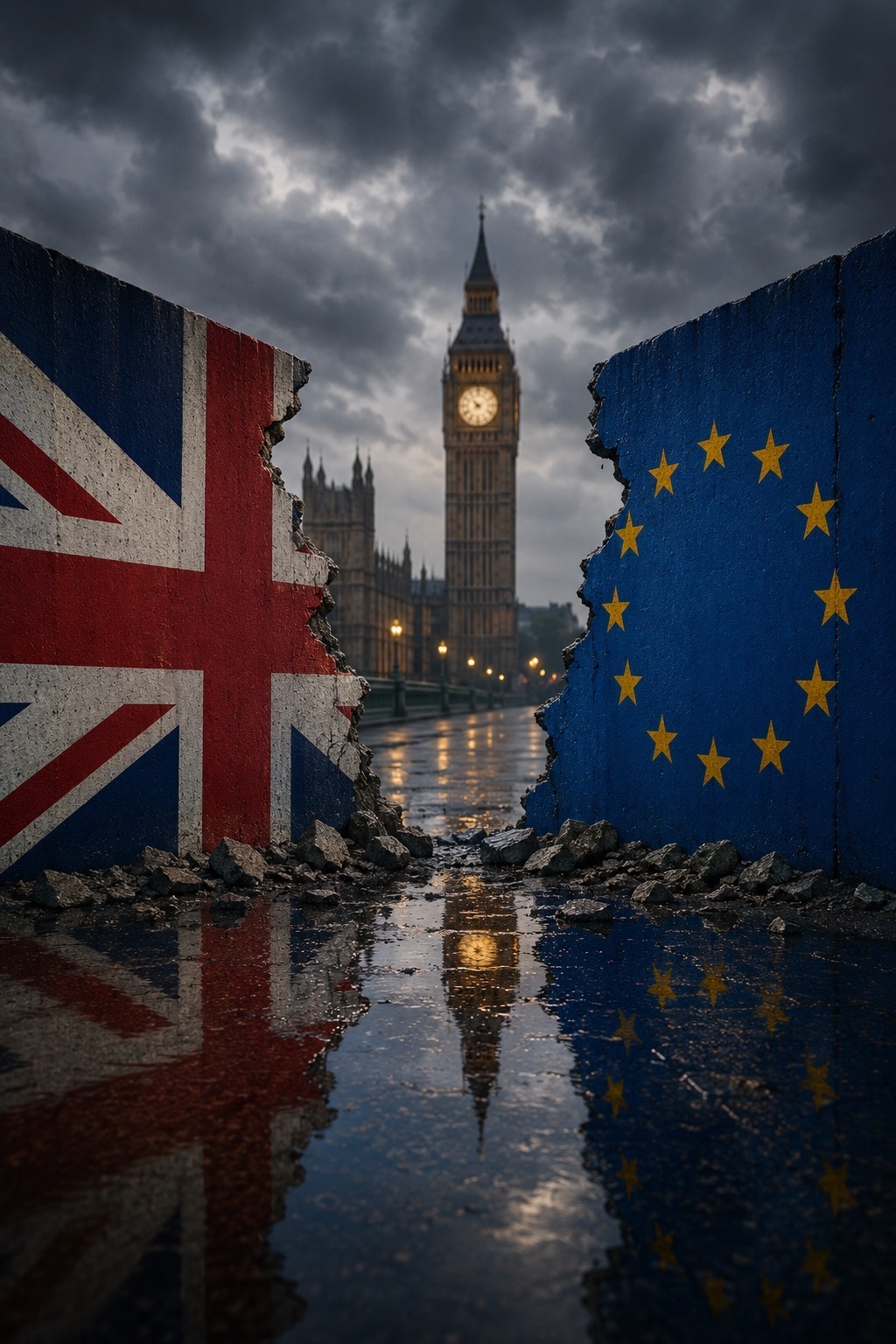
23 June 2026 marks the tenth anniversary of the Brexit referendum. It promised greater control over borders, laws and economic policy. Ten years on, however, the British economy is facing a significant slowdown, the country’s governance has rarely appeared so unstable, and anti-immigration rhetoric has intensified in an increasingly divided society.
 Marwan Nabli
“Not all of these difficulties are due to Brexit, I am simply convinced that Brexit makes everything more difficult”, tweeted Michel Barnier, the EU’s former Brexit negotiator, on the 20th of October 2022, the day after Liz Truss resigned.
The fourth Prime Minister since 2016 served for only 45 days and symbolized the kingdom’s growing political instability following the referendum. Only during the Regency/post-Regency era, between 1827 and 1837, did Britain experience such a rapid succession of prime ministers.
The Conservatives have not been part of government since 2024. The Labour Party, and Keir Starmer, who have been leading the government for two years, are facing a crisis of public confidence that is only deepening.
This dynamic was further highlighted during the 7 May local elections, in which Labour suffered a historic loss to Reform UK — a far-right sovereigntist party that captured 26% of the vote nationally — while alternative parties such as the Greens also gained ground.

“Brexit changed the political identity of the United Kingdom”, argues Peter Cook, a British keynote speaker, author, and organisational development consultant who spoke with The Prisma.
He writes the political commentary and newsletter series Reboot Britain (also known humorously as Rage Against The Brexit Machine, together with five books, protest music, films and participative events.
He is known for blending leadership and business strategy with political advocacy, specifically focusing on social, economic, environmental and political reform in the UK and the removal of Brexit. He says that “it’s fragmented the political system into at least five parties… When combined with a first past the post system so that is broken.”
The leader of the lobbying network “Reboot Britain” judges the success of the Leave campaign as “a failure of David Cameron’s ‘Remain campaign’. He didn’t think he was going to lose. Nigel Farage and Boris Johnson came with populist campaigns and slogans that you hear at a football match; they had much better marketing communications.”
Cook also remembers that there was a general lack of knowledge concerning the effects of Brexit: “The day after the referendum took place, the most Googled subject in the UK was What is Brexit?”
One of the key arguments promoted by Brexit supporters during the 2016 campaign was the need to reassert British control over economic policy.
Three years after the referendum, the Brexit process is estimated to have reduced UK productivity “by between 2% and 5%”, according to the Bank of England. Another study published by the same bank also shows that “over the past three years, cumulative growth in investment spending has been just 0.4%.”
After the Truss government’s “mini-budget” in 2022, the pound hit its lowest level against the US dollar in modern British history (£1 = $1.0327), according to Euronews.
In October 2025, the International Monetary Fund (IMF), quoted by Reuters, stated that, “UK inflation remains the highest in G7. Consumer price inflation is forecast to average 3.4% in 2025 and 2.5% in 2026.”
And this is directly reflected in the prices of necessities, according to the anti-Brexit campaigner: “Food prices have gone up 20% to 30%. Cheese has a security tag. French cheese and other hard to import goods are hardly stocked in any Aldi and other supermarkets.”
The UK’s economy is under strain, Cook says: “We are losing about £240 billion every year.” In addition to that, “with slower hiring, unemployment has risen to 5% in Q3 2025”, reported the UK government.
“I explain to people who don’t do numbers that it’s rather like trying to swim the English Channel with a ten-kilogram block of concrete around your neck”, says Peter Cook.
 In his words, “it’s a catastrophic effect. The trouble is, it’s happening in slow motion, not everyone experiences it, and it’s all mixed in with Covid, Ukraine, Trump which makes it harder for people to separate out the Brexit impacts as time goes by.”
Freedom of movement between the United Kingdom and European Union countries has, of course, also been reshaped following Brexit.
“The UK has implemented a points-based immigration system that prioritizes skills and talent over a person’s country of origin,” the government reports. However, this selection process has led to a shortage of skilled workers in certain occupations that are essential to the British economy: “If you go to a hotel, there’s no staff anymore because most Europeans left. This applies to other sectors such as our NHS, farming etc.”, Cook observes.
Magda Borkowska and James Laurence, from the Institute for Social and Economic Research (ISER) of the University of Essex, found that, during the referendum campaign, contact—or lack thereof—with different ethnic groups was a determining factor in how certain voters cast their ballots: “Majority group individuals living among higher shares of non-Whites were less likely to vote for Brexit, while those in areas experiencing a larger increase in the share of non-Whites (between 2001 and 2011) are more likely to vote for Brexit.”
 Anti-immigration rhetoric has increased, and this was also reflected in a sense of apprehension shared by immigrants: “The main reaction was fear; people were terrified of being identified”, reports Cook, who recently recounted confronting a man on a bus, who was making racist remarks: “I stood up and said: ‘Get off the bus’”.
The immigrants had sat through 35 minutes listening to this. “They chose to keep quiet”.
The results of the latest local elections, the recent far-right marches led by the anti-Islam activist Tommy Robinson, and the new immigration rules announced by Westminster reveal an increasingly deep fracture across the UK.
Paradoxically, more people are coming because “we have no mechanism to send them back” after Brexit. “We used to have a mechanism via the Dublin Agreement to send people back if we didn’t want them to stay here. We no longer can use that because we’re a third country”, argues Cook.
Immigrants now have to wait 10 years to get a settled status. Peter Cook says that “you can’t settle and make your life with your family in a country where you might be booted out in 10 years time.”
 He also remembers a time not so far away when Britons opened their arms: “When Ukrainians came here, there was friendliness. However, people forget things quickly. It’s now a stranger danger feeling that prevails.”
Peter Cook observes that “Leave voters didn’t like the Romanians much, but they like the Iranians and other faraway nations even less. Of course, they still want their operations, Deliveroo, taxis, IT support etc. Be careful what you wish for.”
Nowadays, the “boats” of refugees that cross the Channel have become the most discussed topic in UK politics. Although “a large proportion of the British public still believes that net migration is continuing to rise, when it has actually fallen by more than three-quarters”, according to a British Future report published ahead of the latest government figures on migration, on 21 May 2026.
Overall, since 2016, the UK has no longer been subject to EU law but is grappling with a sluggish economy. “It has not changed any significant laws in that time, blowing a hole in the myth that we wanted our own laws”, Cook adds.
The country has never managed to fully “take back control” of its borders, as net migration reached a historic peak of 906,000 in the year ending June 2023, according to revised estimates from the Office for National Statistics (ONS), the highest level recorded in the series.
The UK government has also created a discriminatory reception system based on selecting workers according to economic needs and giving priority to skilled workers.
 Parliament faces historic instability. Cook affirms that: “five Prime Ministers have been ‘consumed’ by Brexit, and Keir Starmer looks like he might be next.”
Peter Cook is trying to persuade a lot of his fellow countrymen that “rejoining” would be simple, but he faces a reality: “Brexit is a quasi-religion… You can’t change it by giving people facts… You have to listen to their story and that takes time, skill and patience. I call the processes we need Brexorcism.”
‘Taking back control’ was the main idea, but ten years on, it seems difficult to see how this has benefitted the UK. On the other hand, it is easier to understand what it has cost.
(Photos: Pixabay)










.jpg)












