
Sophie Bell reports on the fight back after months of anti-refugee protests.
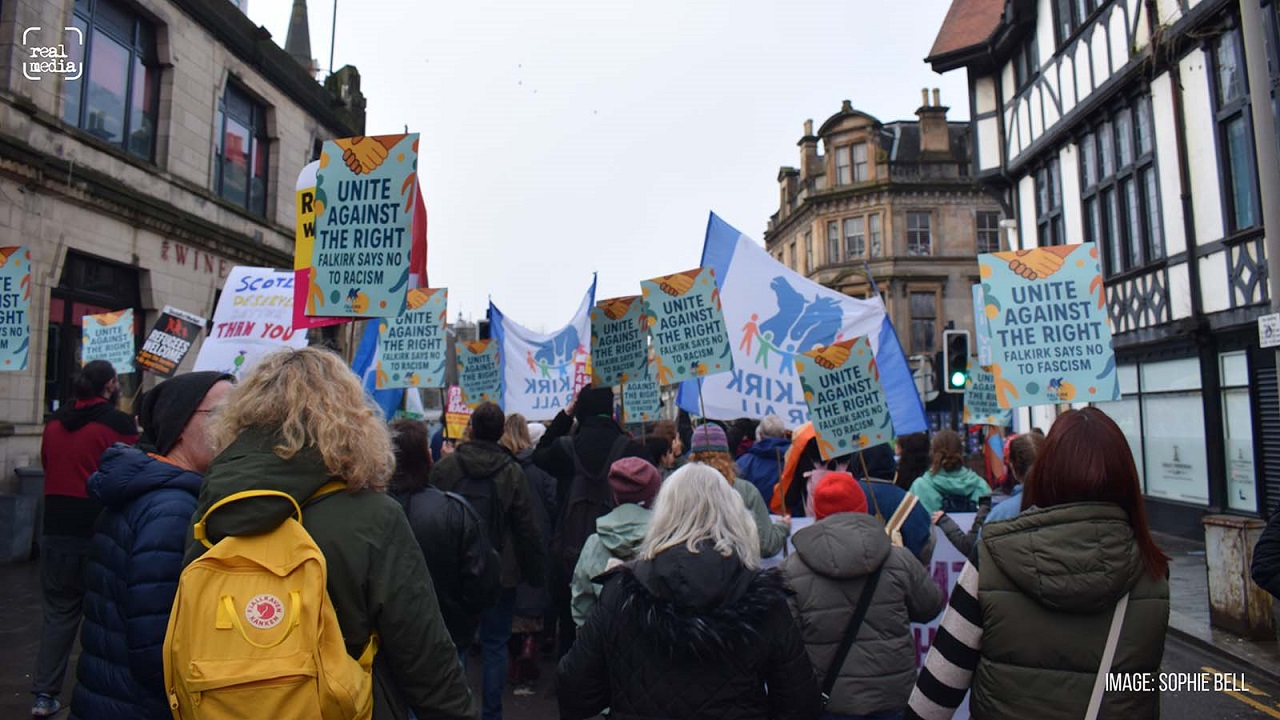

Hundreds of people joined a Unity Rally in Falkirk on 7 December, marking the largest show of solidarity yet in a town that has spent months at the centre of Scotland’s escalating tensions over immigration, misinformation and far-right mobilisation.
For more than three months, anti-refugee protesters have gathered outside the Cladhan Hotel, where around 90 asylum-seeking men are being housed while they await decisions on their claims. Many of the men living in the hotel have fled conflict, persecution or torture in countries including Iran, Sudan, Eritrea and Afghanistan. Residents have become a captive audience to chants of “send them back” and “stop the boats”, fuelling tension both at the hotel and across the wider community. Local anti-racism groups have held regular counter-protests.
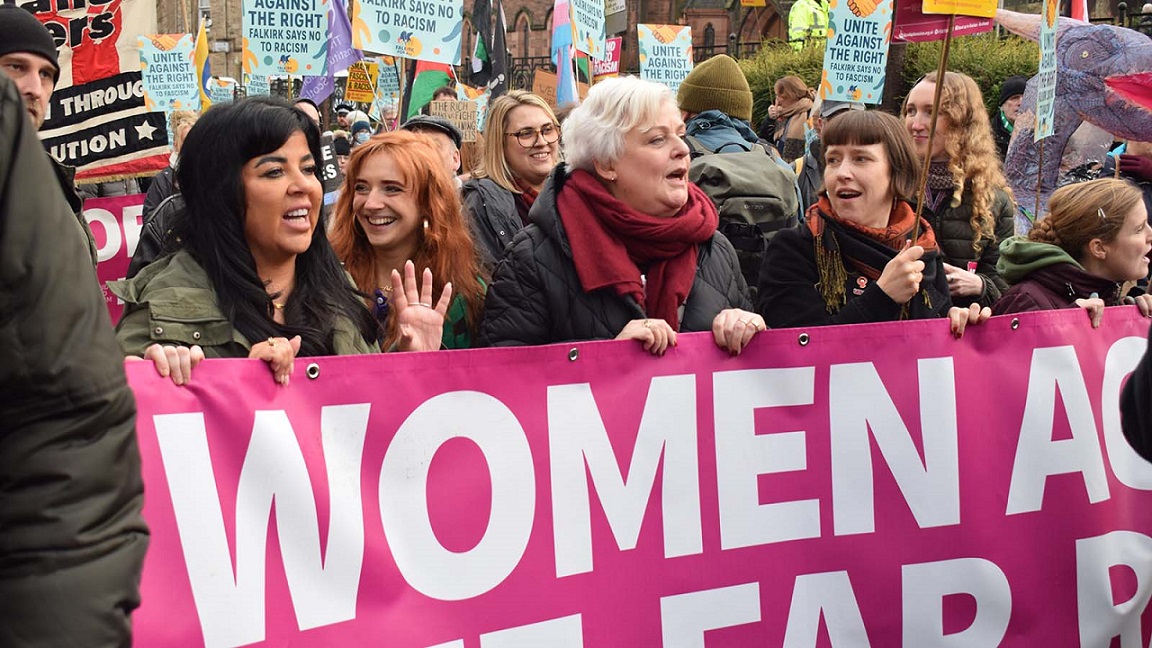
The Unity March, organised by Falkirk for all and supported by Stand Up to Racism Scotland, Women Against the Far Right Scotland, trade unions, faith groups and local volunteers, aimed to shift the mood in the town.

It was a typical grey winter day in Falkirk, and an extra chill hung in the air as the march took place just hours before Nigel Farage’s sold out “Scotland Needs Reform” event at the Macdonald Inchyra Hotel, four miles away, where around 750 attendees were expected. Reform UK rejected accusations from local SNP MSP Michael Matheson that the event was timed to “stoke division”, insisting the venue was chosen solely for its capacity. Farage had already caused controversy earlier in the week by claiming immigration had led to the “cultural smashing” of Glasgow, comments condemned by refugee charities including
Positive Action in Housing, particularly after he singled out multilingual schoolchildren.
To many in Falkirk, the timing of his visit felt far from accidental.
In recent months, Scotland has seen a rise in far-right organising, and Falkirk has become one of its main targets. For local anti-racist groups, Saturday’s march, described as “the big one”, was an attempt to reclaim Falkirk’s identity from those they say are weaponising fear.
Tensions in Falkirk escalated after the conviction of Sadeq Nikzad, a former hotel resident imprisoned for nine years in June for the rape of a 15 year-old girl. The case has since been repeatedly used by far-right groups to portray all asylum seekers as dangerous. And just last week, another resident of the Cladhan Hotel appeared in court charged with two sexual assaults. In 2023, the same year as Nikzad’s offence, Falkirk recorded 82 reports of rape or attempted rape – no other incidents have been linked to people living at the Cladhan Hotel.
Local anxieties about safety have been amplified by the rhetoric of far-right groups.
During Saturday’s demonstrations, anti-refugee protesters outside the hotel threw blue flares and full drinks bottles towards the anti-racism counter-protest, while shouting abuse across the police line. The pro-refugee side responded with pop music, dancing and chants of “Refugees are welcome here”.
Inside the hotel, one resident stood watching from a window, while others carefully peered through the blinds.
 Scottish Greens MSP Maggie Chapman, who joined the Unity Rally, told the crowd: “There is no place for racism on Scotland’s streets, and no place for fascism in Scotland’s future.”
Elsewhere in Scotland, similar tensions played out. In Inverness, Highlands Against Hate held its own anti-racist demonstration outside Cameron Barracks, responding to local hostility to government plans to place 300 asylum seekers there.
Falkirk, Inverness and other communities are being shaped not only by the presence of asylum seekers, but by a broader political struggle over fear, identity and who gets to speak for the community. With elections approaching and far-right movements gaining traction, Falkirk’s experience may prove to be a warning for the rest of Scotland.
*Article originally published in Real Media.
(Photos: Real Media)
 Special Edition on Migration
The diaspora beyond fear and misinformation
Life at the U.S-Mexico border under Trump administration
I came to the UK for a better future; now I’m stuck in the visa trap
“I wasn’t taught about colonialism in school, so I taught myself”
“Borders for me are a geography of pain”: A Kurdish journalist’s path to Sheffield
How local communities are rejecting media panic over immigration
Diaspora in London: stories of journeys, resilience and creativity
Hundreds march for unity in Falkirk
The Yemeni journey in Sheffield: struggle, solidarity and renewal
Violence against women, a weapon for racist propaganda
Seven activist documentaries available for free
Influence of the media on perceptions of migrants
From surviving the war to facing racism and xenophobia
When multiculturalism becomes a political weapon










.jpg)












